 English
 Español
 Deutsch
 Português
 italiano
 Français
 عربى
عربى
 Oct 02, 2026 - By admin
How to Plan an Outdoor Covered BBQ Area: Cover Types, Layout, Materials
Oct 02, 2026 - By admin
How to Plan an Outdoor Covered BBQ Area: Cover Types, Layout, Materials
Content
- 1 Match the Cover Type to the Weather, Not to the Photograph
- 2 The Clearances That Decide Whether the Space Works
- 3 Layout Shapes and How They Change the Covered Footprint
- 4 Why 304 Stainless Is the Baseline Under a Cover
- 5 Drainage, Airflow and Grease: The Details That Fail First
- 6 What Buyers and Distributors Should Verify Before Ordering
A grill left in the open looks fine in July and shows pitting by the following spring. The cover over an outdoor covered BBQ area decides almost everything that happens after that: how much wind-driven rain reaches the burners, how far smoke and grease travel, and whether the counter is still usable when the weather turns. The short version is that overhead shade is not coverage. A roof that stops vertical rain still lets wind push water sideways into a firebox, and a grill sitting in that damp pocket will corrode long before its warranty runs out.
What follows is the practical version of the decisions that actually change the outcome: which cover type suits which climate, the clearances that keep the space comfortable instead of cramped, the layout shapes that fit real yards, and the material and drainage details that determine how the area looks in year five.
Match the Cover Type to the Weather, Not to the Photograph
A slatted pergola is the most photographed option and the least protective. It breaks direct sun and light showers, but anything driven by wind reaches the grill. If the site faces prevailing rain, the cover has to close on at least one side, and the grill has to remain operable with that side open.
Four structures cover most residential and commercial installations. The table below compares them on the things that matter after the first winter.
| Cover type | Rain protection | Sun protection | Grill usable while covered | Best suited to |
|---|---|---|---|---|
| Slatted pergola | Low | Partial | Yes | Dry, mild climates |
| Solid roof, open sides | Medium | High | Yes | Mixed climates with driving rain |
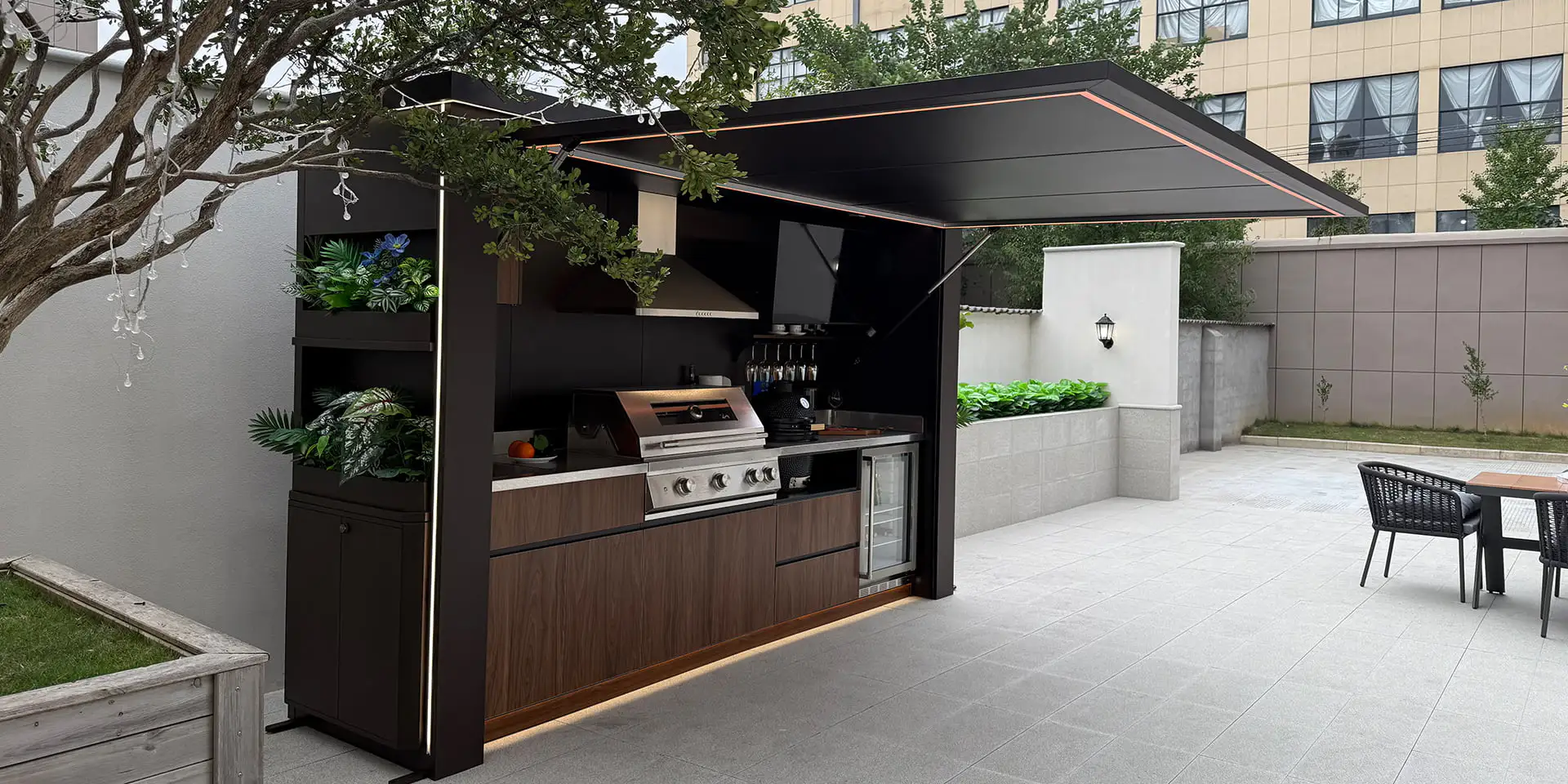
| Lift-up door pod | Medium | High | Yes, door raised | Compact patios and terraces |
| Roller-blind pod | High | High | Yes, blind partly raised | Coastal and wet regions |
| Roller-shutter pod | High | High | Yes, shutter raised | Rental villas and security-sensitive sites |
For buyers who want a fixed structure rather than an extension to the house, the roller-blind format is the middle ground. The blind rolls down to seal the unit when it is idle and lifts clear during cooking, which handles sideways rain better than a pergola at a fraction of the cost of a masonry enclosure.
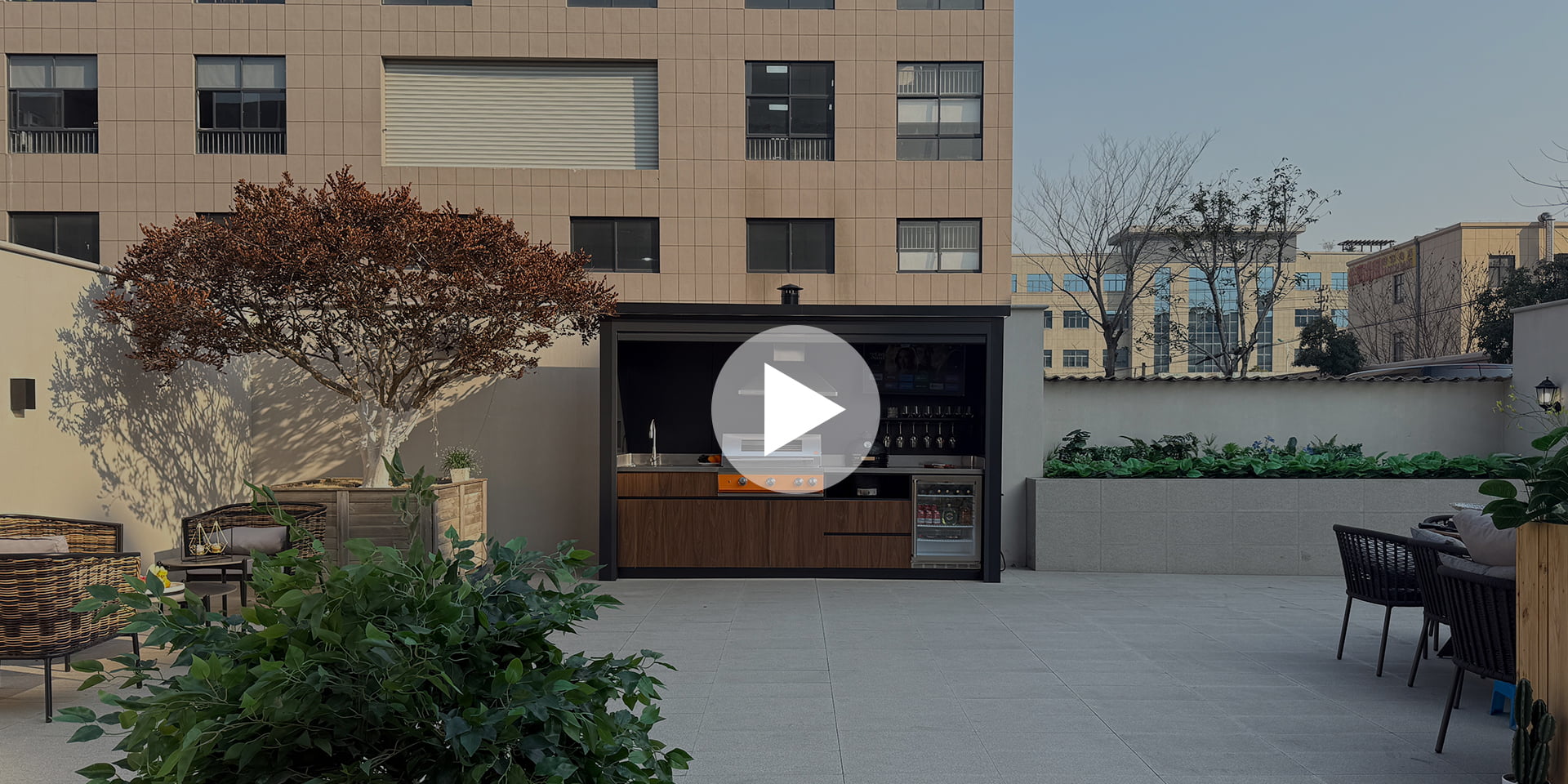 Custom Roller Blind BBQ Pod Manufacturer and Roller Blind BBQ Pod CompanyOur diverse product portfolio is created to elevate the modern living experience. From outdoor intelligent BBQ pods, multifunctional tool cabinets, and outdoor kitchen...View Product →
The Clearances That Decide Whether the Space Works
Most covered BBQ areas fail on dimensions rather than on design. The grill fits, the roof goes up, and then nobody can stand behind the counter or open the lid without hitting a beam. Four numbers cover most of it.
- Counter height: 36 inches (about 91 cm) is the working standard outdoors; taller users often prefer 37 to 38 inches.
- Walkway behind the counter: 36 to 42 inches. Below 36 inches, two people cannot pass without turning sideways.
- Lid clearance: a built-in grill needs its full open-lid height plus roughly 6 inches of air above it, which usually means 30 to 36 inches between the cooking surface and any overhead structure.
- Clearance to combustibles: keep at least 24 to 30 inches of open space to timber, fabric or vinyl, and follow the grill maker's stated figure, which overrides any rule of thumb.
Where a hood or roof beam sits lower than that, the usual fix is to move the grill to the open edge of the covered zone rather than raise the structure. Grills at the edge also vent better and keep smoke out of the seating area.
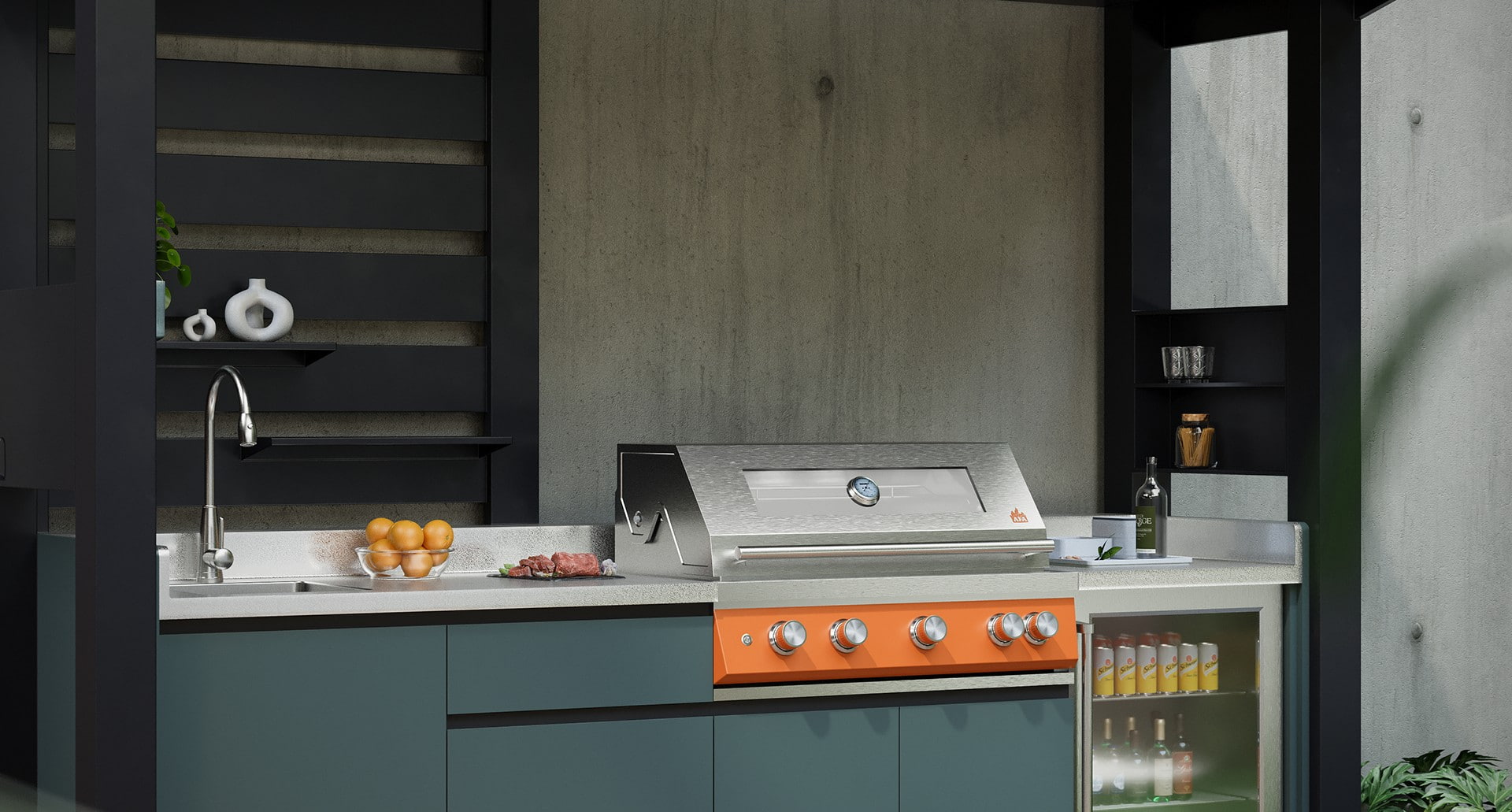 Custom 36" Built In BBQ Grill Manufacturer and 36" Built In BBQ Grill CompanyOur diverse product portfolio is created to elevate the modern living experience. From outdoor intelligent BBQ pods, multifunctional tool cabinets, and outdoor kitchen...View Product →
Layout Shapes and How They Change the Covered Footprint
Once the clearances are fixed, the counter layout decides how much roof is actually needed. Five shapes cover nearly all residential projects, and each one has a different relationship with the cover above it.
- Linear: everything in one run under a single roof span. Cheapest to cover, easiest to ventilate, best fit for narrow patios.
- L-shaped: adds a return leg, usually for a sink or a refrigerator, and works well when the cover follows two walls of a house corner.
- U-shaped: three sides, one open. Good for separating cooking from seating, but the enclosed shape traps smoke unless the open face points into the prevailing breeze.
- G-shaped: a U with a short return that creates a bar or serving ledge, popular where the grill area also hosts guests.
- Diamond-shaped: angled units for irregular plots and corner gardens where straight runs would waste space.
The practical rule is that the more sides a layout closes, the more the open side matters. A U-shaped kitchen under a solid roof with no cross-breeze will hold smoke at head height, which is why the open face should point away from the house.
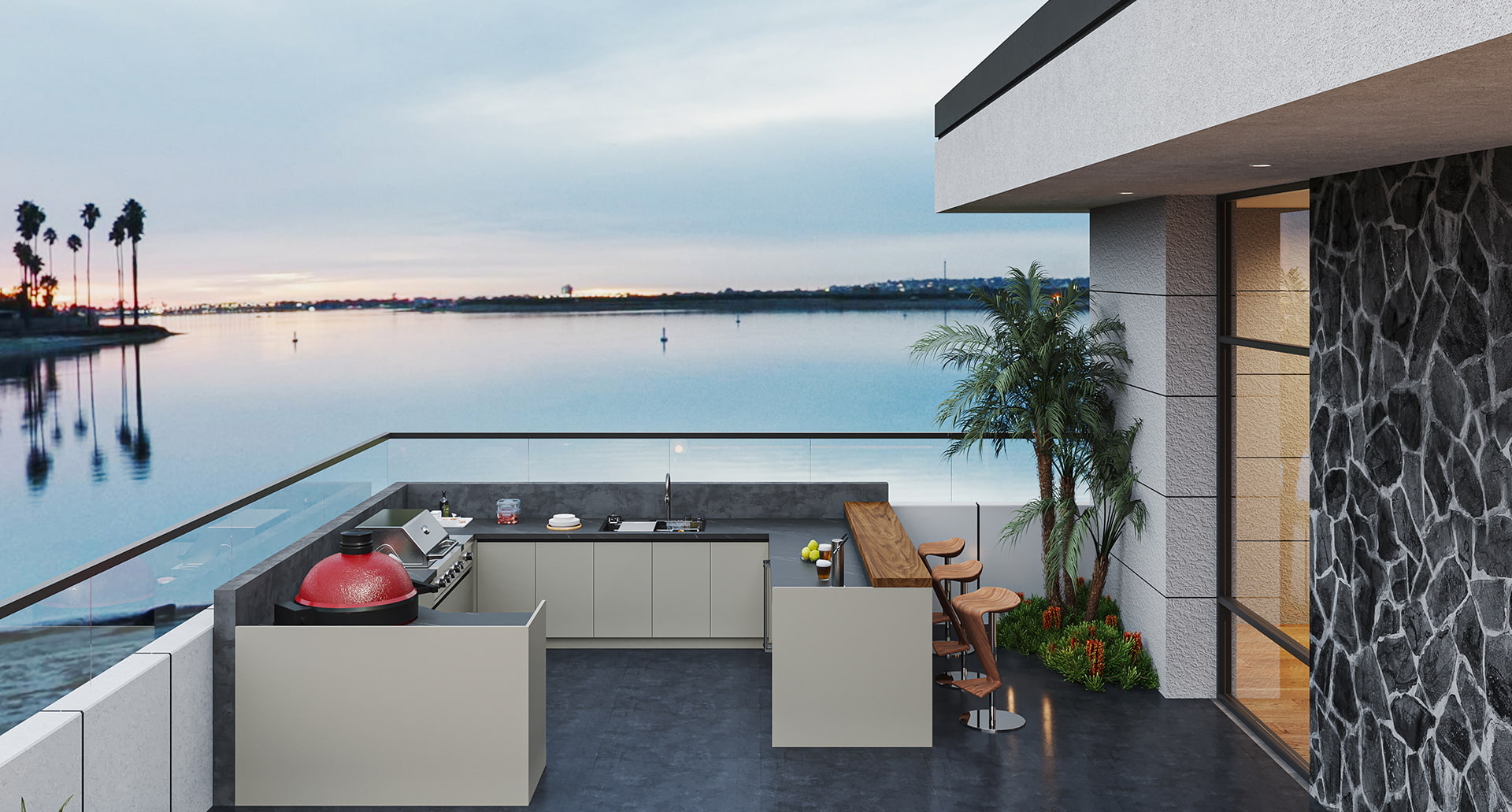 Custom U-SHAPED Outdoor Kitchen Cabinets Manufacturer and U-SHAPED Outdoor Kitchen CabinetOur diverse product portfolio is created to elevate the modern living experience. From outdoor intelligent BBQ pods, multifunctional tool cabinets, and outdoor kitchen...View Product →
Why 304 Stainless Is the Baseline Under a Cover
Covered does not mean dry. Water still arrives as spray, condensation and washing. That is why the material specification matters more in a covered area than many buyers expect.
Grade 304 stainless is the sensible baseline for outdoor cabinetry, grills and pod shells. It resists the surface rust that ordinary carbon steel develops and copes with the acids and salts that come with food and coastal air. What it does not resist well is chloride sitting in a wet crevice, which is exactly the condition found where a pod frame meets a floor plate or where a countertop lip traps water.
The answer is design rather than a more exotic alloy: drain holes at low points, no flat ledges wider than about 10 mm, and a slight fall on every horizontal surface so water leaves instead of pooling. Sites within a few hundred metres of salt water are the one case where grade 316 justifies the extra cost. The behaviour of stainless under long-term outdoor exposure, including the pitting patterns worth checking, is covered in our guide to stainless steel rust on BBQ pods and how to fix it.
Drainage, Airflow and Grease: The Details That Fail First
Water paths
Every covered structure needs a defined route for water: gutters or a drip edge on the roof, a fall on the counter, and a gap between the floor plate and the paving so the frame never stands in a puddle. A 5 mm gap is enough. Sealing a pod frame directly onto a slab is the most common cause of rust we see in service.
Airflow
A covered grill needs cross-ventilation above and below the cooking surface. Leave the back of the enclosure open, or fit louvres, so hot air can escape and gas cannot collect in a dead pocket. Where a gas bottle is stored inside a cabinet, the enclosure must be vented at both high and low level.
Grease
Grease does not disappear because the unit has a roof. Fit a removable tray under the grill, line the cabinet floor with something that can be lifted out, and keep the tray clear of the wall by at least the manufacturer's stated distance. Trays resting directly on stainless steel create a permanent wet contact point.
What Buyers and Distributors Should Verify Before Ordering
For anyone sourcing a covered BBQ area rather than building one, the specification review is where money is saved or lost. Four checks catch most of the risk.
- Drawings, not photographs. Ask for dimensioned drawings showing the closed and open positions of every door or blind, plus the roof overhang.
- Material certificate. Confirm the actual grade and thickness of the stainless sheet, not only the marketing name.
- Mechanism life. Hinges, roller blinds and shutters are the parts that fail. Ask how many cycles they are rated for and whether they can be replaced in the field.
- Spares and shipping. Confirm that handles, rollers and seals are available separately, and that the packed unit fits the container plan you are booking.
These points decide whether a container of units arrives as a sellable product or as a repair project, and they are far cheaper to settle before the order than after it.
Covered outdoor cooking is a small construction project with a long service life, and the details above determine whether it still looks right after five seasons. AFA has been manufacturing stainless steel kitchen and outdoor products since 1993, from a single sink with an integrated waste bin through to today's range of BBQ pods, built-in grills, outdoor carts and modular outdoor kitchen cabinets.
If you are interested in our products, please contact us, or build your specification directly in the configurator.
Copyright © 2025 Ningbo AFA Kitchen and Bath Co.,Ltd. All Rights Reserved. Custom Modular Outdoor Kitchen Manufacturer Outdoor Barbecue (BBQ) Kitchen Factory Privacy Policy
