 English
 Español
 Deutsch
 Português
 italiano
 Français
 عربى

Search
News categories
Recommend News
News categories
Recommend News
 Nov 20, 2026 - By admin
Best Material for an Outdoor Kitchen Frame: Stainless Steel Grades and Buying Guide
Content
- 1 The Short Answer: 304 or 316 Stainless Steel Wins
- 2 Why the Frame Material Matters More Than the Finish
- 3 Material Comparison for Outdoor Kitchen Frames
- 4 Stainless Steel Grades: Where 304 Ends and 316 Begins
- 5 Wall Thickness, Welding, and Finish: The Details Buyers Miss
- 6 Match the Frame to the Layout and Exposure
- 7 Coastal, Humid, and Cold-Climate Specifications
- 8 Procurement Checklist for Distributors and Project Buyers
- 9 Where AFA Fits in a Stainless Steel Outdoor Kitchen Project
- 10 Set the Frame Specification Before You Build
The Short Answer: 304 or 316 Stainless Steel Wins
For an outdoor kitchen frame, the best material is stainless steel: 304 stainless for most inland residential and commercial projects, and 316 stainless for coastal, marine, or high-salt sites. A practical starting point is a 1.2–1.5 mm wall for residential frames and 1.5–2.0 mm for commercial or exposed frames, then confirm the grade, weld quality, and finish before ordering. Wood, MDF, and thin powder-coated steel may look correct on day one, but the frame is the part you cannot easily replace after the stone top, grill, and cabinets are set.
Why the Frame Material Matters More Than the Finish
An outdoor kitchen frame carries the countertop, grill, doors, drawers, and storage. It also controls how the assembly behaves when the ground moves, the sun heats the top, and rain sits in joints. A powder-coated finish can hide a low-grade substrate for a season; it cannot correct a frame that flexes under a 42-inch grill or rusts from the inside of a welded tube.
Start with the exposure. A covered patio in a dry climate is a different risk from a rooftop in a humid region or a backyard 200 meters from the sea. Salt, chlorine from pool water, fertilizer, and standing water all attack the frame at cut edges, welds, and fasteners. That is why material control belongs in the specification, not in the after-sales conversation. For a manufacturer's view of how incoming stainless is handled, see AFA's raw material page.
Material Comparison for Outdoor Kitchen Frames
| Material | Corrosion resistance | Structural behavior | Best use | Main risk |
|---|---|---|---|---|
| 304 stainless steel | Good in most inland climates | Strong, stiff, weldable | Residential and commercial frames away from salt | Rust staining in coastal or chloride-rich sites |
| 316 stainless steel | Very good in coastal and marine air | Strong, weldable, similar to 304 | Coastal homes, poolside kitchens, humid regions | Higher cost; still needs correct welds and drainage |
| Galvanized steel | Moderate until coating is damaged | Strong and economical | Hidden framing with limited moisture exposure | Cut edges and welds rust first |
| Powder-coated aluminum | Good if coating stays intact | Lighter, lower stiffness; needs larger profiles | Island frames where weight matters | Galvanic corrosion at stainless fasteners; coating chips |
| Wood or composite | Poor to moderate | Moves with moisture; less stable | Temporary or protected setups | Rot, swelling, and joint movement |
The table points to a simple purchasing rule: use stainless where the frame is visible, load-bearing, or difficult to service. If the frame is fully hidden and kept dry, galvanized steel can work, but the savings disappear when cut edges are not sealed and the client sees rust bleeding through a stone base.
Stainless Steel Grades: Where 304 Ends and 316 Begins
Type 304 is the default outdoor stainless. It typically contains about 18% chromium and 8% nickel, which gives it good formability and resistance to atmospheric corrosion. It is suitable for most backyard frames, cabinet bodies, and supports when the site is not exposed to salt spray. Type 316 adds 2–3% molybdenum, which improves resistance to chlorides. That matters near the ocean, around pools, and in industrial or humid environments where condensation stays on the metal.
The grade decision should follow the site, not the showroom. A 304 frame can last for years under a roof in a low-humidity area. The same frame 300 meters from breaking surf may show tea staining within months, especially at welds and laser-cut edges. For coastal projects, specify 316 for the frame and for visible fasteners, hinges, and screws. Mixed grades are a common source of early corrosion: a 304 screw in a 316 frame can still stain the surrounding surface.
Wall Thickness, Welding, and Finish: The Details Buyers Miss
Grade alone does not make a frame durable. Two suppliers can offer “304 stainless” and deliver very different assemblies. Check these points before approving a sample:
- Wall thickness: verify with a micrometer at three points per tube. For residential frames, 1.2–1.5 mm is a practical starting range; commercial or coastal frames often justify 1.5–2.0 mm. Allow no more than ±0.05 mm against the approved specification and reject mixed bundles.
- Welding and passivation: look for controlled TIG welds, full penetration at load joints, and post-weld passivation or pickling. Grinding a weld and brushing the surface is not a substitute for restoring the passive layer.
- Geometry: check squareness within 1.5 mm per meter, consistent door gaps of 2–3 mm, and flatness where the countertop lands. A frame that is twisted by 5 mm will force shims and sealant on site.
- Drainage and isolation: confirm weep holes, slope, and separation between stainless and aluminum parts. Trapped water and galvanic contact are frame killers even when the base metal is correct.
Finish is the last step, not the first. A No. 4 brushed finish hides fingerprints and minor scuffs, while a smooth 2B finish is easier to clean but shows handling marks. Anti-fingerprint coatings can help on visible cabinet fronts, but they do not replace the grade and weld quality underneath.
Match the Frame to the Layout and Exposure
A linear run is the simplest frame to brace: two end panels, a continuous rear rail, and a countertop support every 600–800 mm. L-shaped and U-shaped layouts need corner gussets and diagonal bracing, because the frame must resist racking from doors, drawers, and a heavy grill lid. For a compact linear outdoor kitchen, the linear outdoor kitchen cabinet line shows how a stainless cabinet frame is organized around a straight run.
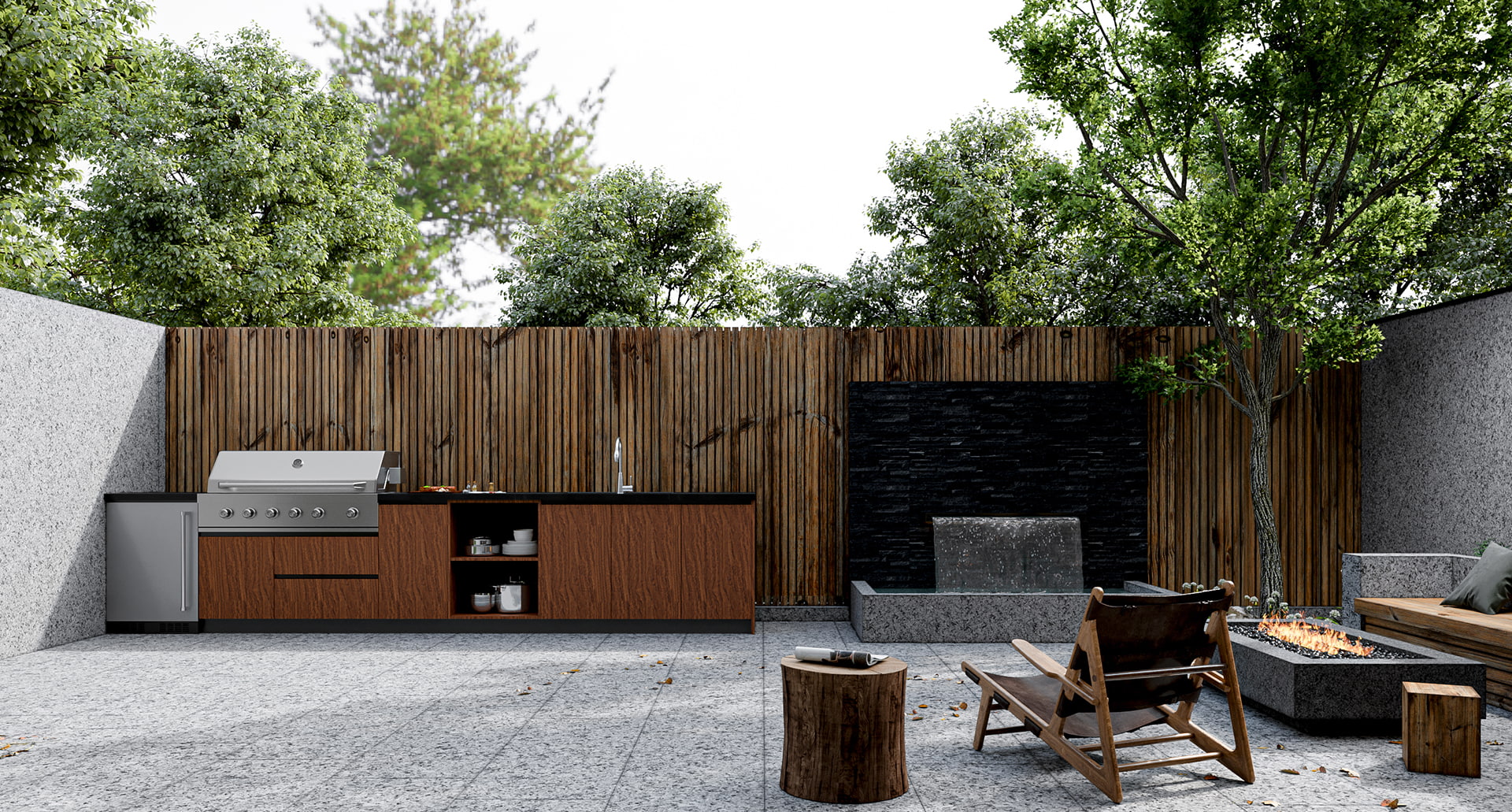 LINEAR Outdoor Kitchen Cabinets for Compact PatiosCompact linear cabinet system integrates grill, sink, refrigerator, trash storage, and cabinets, with two-sided function display for small patios.View Product →
For a corner layout, the L-shaped format adds the return leg and corner support that a straight frame cannot provide.
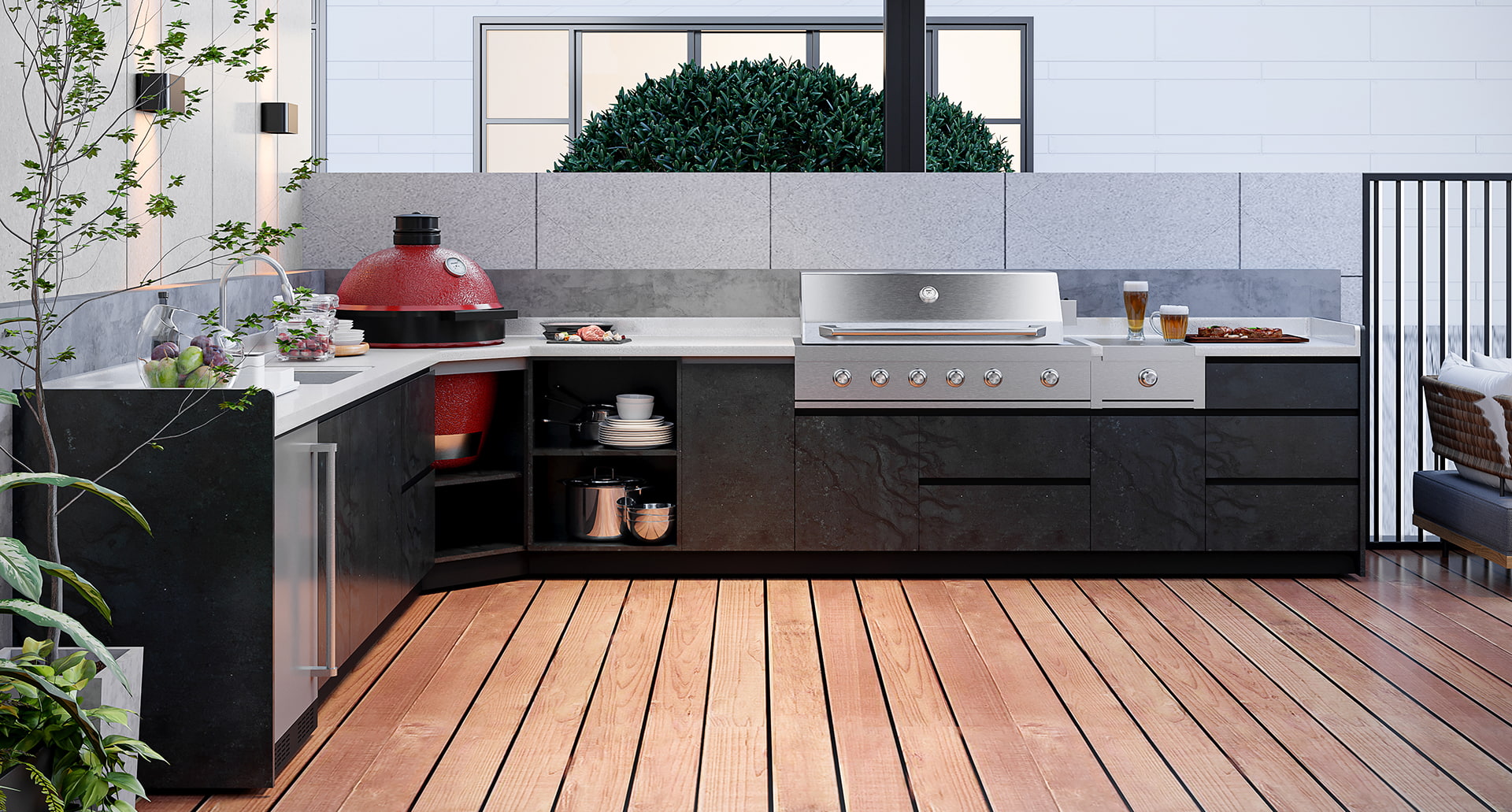 L-Shaped Outdoor Kitchen Cabinets for Corner LayoutsCustom L-shaped cabinet layout adds a return leg and two-sided function display to streamline washing, cutting, and grilling in outdoor gazebos.View Product →
Do not size the frame from the grill alone. Add the countertop overhang, door swing, drawer pull clearance, and the space needed to lift a grill lid. A 42-inch built-in grill may need a clear opening plus a service gap, and the frame must carry the grill plus the countertop without relying on the cladding for stiffness.
Coastal, Humid, and Cold-Climate Specifications
Coastal projects justify 316 stainless for the frame, visible fasteners, and any bracket that will see salt spray. Specify a post-installation wash-down plan, because salt sits in seams and under countertop edges. Poolside kitchens need the same attention: chlorine and splash zones are not the same as open coastal air, but both raise the risk of chloride attack.
In cold climates, water can freeze in hollow tubes and open joints. Provide drain holes at the low point of each frame section and avoid sealed pockets that can hold condensation. Humid climates call for ventilation behind closed cabinets and a finish that does not trap moisture. In all three cases, the frame should be detailed so water leaves the assembly instead of drying inside it.
Procurement Checklist for Distributors and Project Buyers
- Request the mill certificate and match the heat number to the delivered tubes or sheets.
- Approve a production sample, not a rendered image; check weld color, passivation, and cut-edge treatment.
- Use ASTM B117 salt-spray testing as a comparison tool between suppliers, not as a guarantee of service life.
- Confirm stainless fasteners and isolating washers where aluminum or dissimilar metals meet.
- Check packaging: tube ends need protection, and flat surfaces need interleaving to prevent transit scratches.
- Agree on a measurable inspection standard for squareness, wall thickness, door gaps, and weld finish.
These checks matter most for export orders, where a container load cannot be sorted on site. A distributor who buys on price alone often pays later in replacement parts, local rework, and damaged channel relationships.
Where AFA Fits in a Stainless Steel Outdoor Kitchen Project
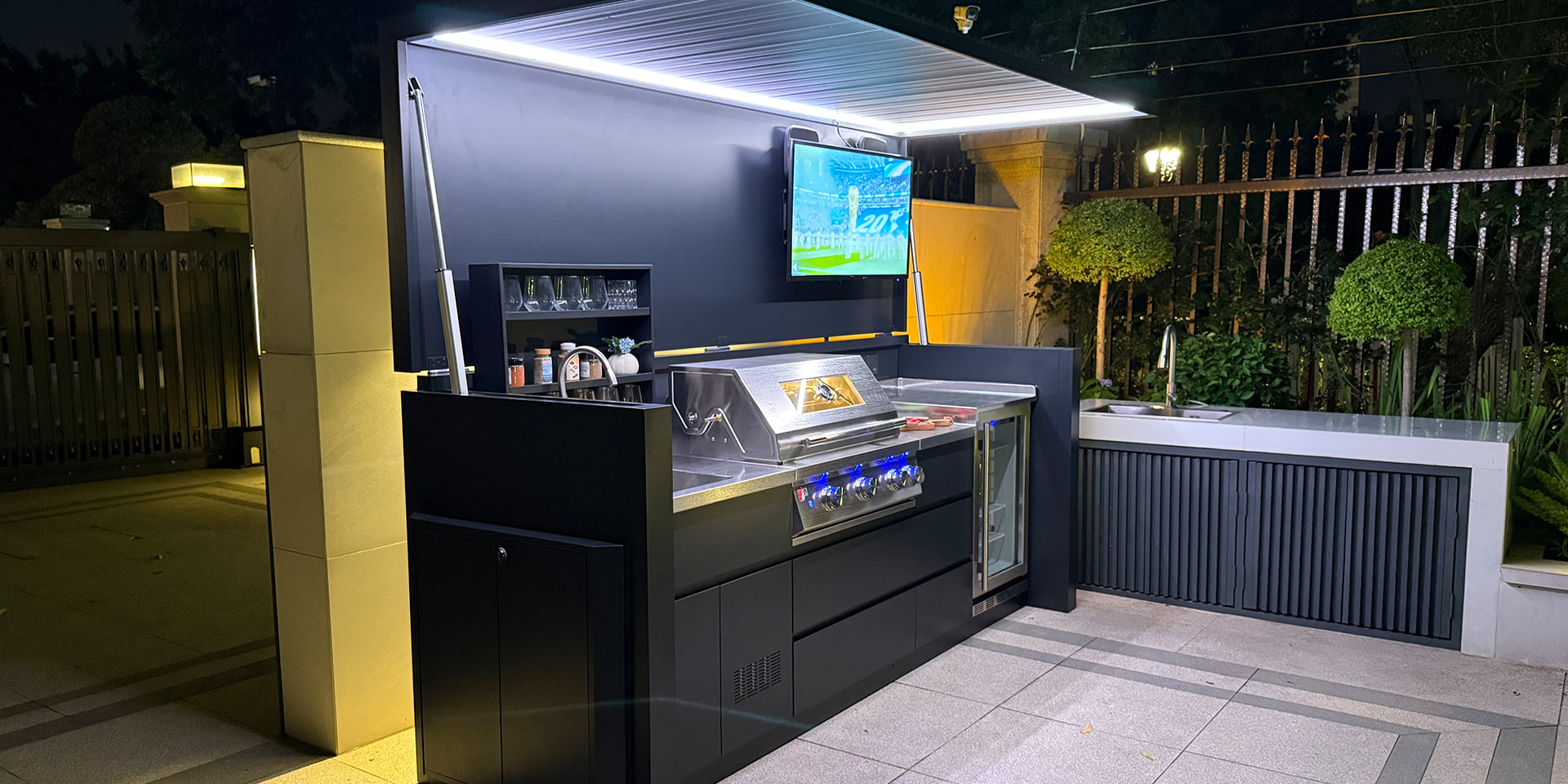
AFA has manufactured stainless steel products since 1993 and operates three production bases totaling 45,000 m², with product lines that include outdoor kitchen cabinets, built-in grills, BBQ carts, and BBQ pods. That background is useful when the frame must match a cabinet system rather than stand alone. For exposed sites where the cooking zone needs a roof and a closable shell, the pavilion-style BBQ pod shows how a stainless frame can be integrated with doors, panels, and weather protection.
 P-Series Pavilion Style BBQ Pod with Retractable RoofStandalone outdoor kitchen pod with remote motorized roof, 304 stainless frame, 36-inch grill, sink, refrigerator, speakers, and storage for semi-open courtyards.View Product →
The specification should still be written around the project: grade, wall thickness, weld standard, finish, drainage, and hardware. A manufacturer with in-house stainless processing can control those details, but the buyer must define them clearly in the purchase order.
Set the Frame Specification Before You Build
If you are comparing materials for a residential patio, a distributor catalog, or a hospitality project, the safest path is to lock the grade and wall thickness first, then design the layout and finish around them. If our stainless steel outdoor kitchen cabinets, BBQ pods, or frame components fit your product plan, please contact us and use our configurator to review the available series and sizes.
Copyright © 2025 Ningbo AFA Kitchen and Bath Co.,Ltd. All Rights Reserved. Custom Modular Outdoor Kitchen Manufacturer Outdoor Barbecue (BBQ) Kitchen Factory Privacy Policy
