 English
 Español
 Deutsch
 Português
 italiano
 Français
 عربى
عربى
Search
News categories
Recommend News
News categories
Recommend News
 Oct 16, 2026 - By admin
Stainless Steel Outdoor Kitchens: Climate, Grades, Layouts, and Buying Checks
Oct 16, 2026 - By admin
Stainless Steel Outdoor Kitchens: Climate, Grades, Layouts, and Buying Checks
Content
Three summers in a coastal garden will tell you more about a stainless steel outdoor kitchen than any showroom. The rust rarely appears on the door face first. It shows up at the hinge plate, under the screw heads, along the weld behind a drawer rail, and in the cabinet base where rainwater sits after a storm.
The conclusion is straightforward: choose the stainless grade by climate, choose the enclosure by how the space is actually used, and lock the layout before anyone templates a countertop. The sections below explain how those three decisions interact, which numbers are worth writing into a purchase order, and where budget specifications fail first.
Match the Grade and Gauge to the Climate, Not the Price List
Stainless steel is a family of alloys rather than one material, and an outdoor kitchen sits in the harshest position a domestic product can occupy: rain, salt air, pool chlorine, UV and daily temperature swings. Two grades carry almost all serious outdoor kitchen work. Grade 304, often written 18/8, contains roughly 18% chromium and 8% nickel and is the sensible default for inland patios and covered terraces. Grade 316 adds 2-3% molybdenum, which suppresses pitting in chloride-rich air and is what coastal and poolside projects should specify. A 201 or 430 panel can look identical under showroom lighting and still stain or pit in a salt-air garden within two seasons.
Gauge is the second variable. Door and side panels normally fall between 0.8 mm and 1.2 mm, structural frames should be 1.5 mm or thicker, and work surfaces are usually 1.2-1.5 mm. Then ask about the small parts: zinc-plated hinges, screws and runners inside a 304 body are the most common starting point for corrosion. Welds should be ground and passivated rather than simply polished.
| Grade | Best-fit environment | Where it fails |
|---|---|---|
| 304 (18/8) | Inland patios, covered terraces, suburban yards | Surface tea staining in coastal air if it is never rinsed |
| 316 / marine grade | Beachfront homes, pool decks, salt-spray zones | Higher material cost; still needs periodic washing |
| 430 | Decorative trim, indoor panels, magnetic parts | Poor pitting resistance in wet outdoor use |
| 201 | Budget indoor or fully sheltered products | Not suited to permanent humid or coastal exposure |
One more item belongs in the specification: a salt-spray test report. A cabinet that survives 480 hours of neutral salt spray is a different product from an untested one, even when both datasheets say 304. When comparing quotes, expect 316 to run roughly 20-30% above 304 on material cost, which is still usually cheaper than replacing twelve cabinet doors after the third winter.
Choosing the Enclosure: Door Systems on a BBQ Pod vs Open Cabinets
The most common complaint about outdoor kitchens is not the cooking, it is the upkeep. A grill left open to the weather needs a cover, and a cover that gets put away wet becomes a corrosion blanket. Enclosed pods solve this by turning the cooking station into a sheltered unit that opens when it is used and closes when it rains.
- Lift-up door pods (A series): a single gas-strut panel lifts clear of the counter. Wide, uncluttered opening, but it needs roughly 600-700 mm of clear space behind the unit.
- Roller-shutter pods (B series): interlocking slats roll into the roof. The strongest weather protection of the four, and compact when open.
- Roller-blind pods (C series): a lighter flexible blind that moves quickly and usually costs the least. Best suited to sheltered courtyards.
- Pavilion-style pods (P series): an open structure with a roof, so air keeps moving through it. A good match for hot, humid regions where trapped moisture is the real enemy.
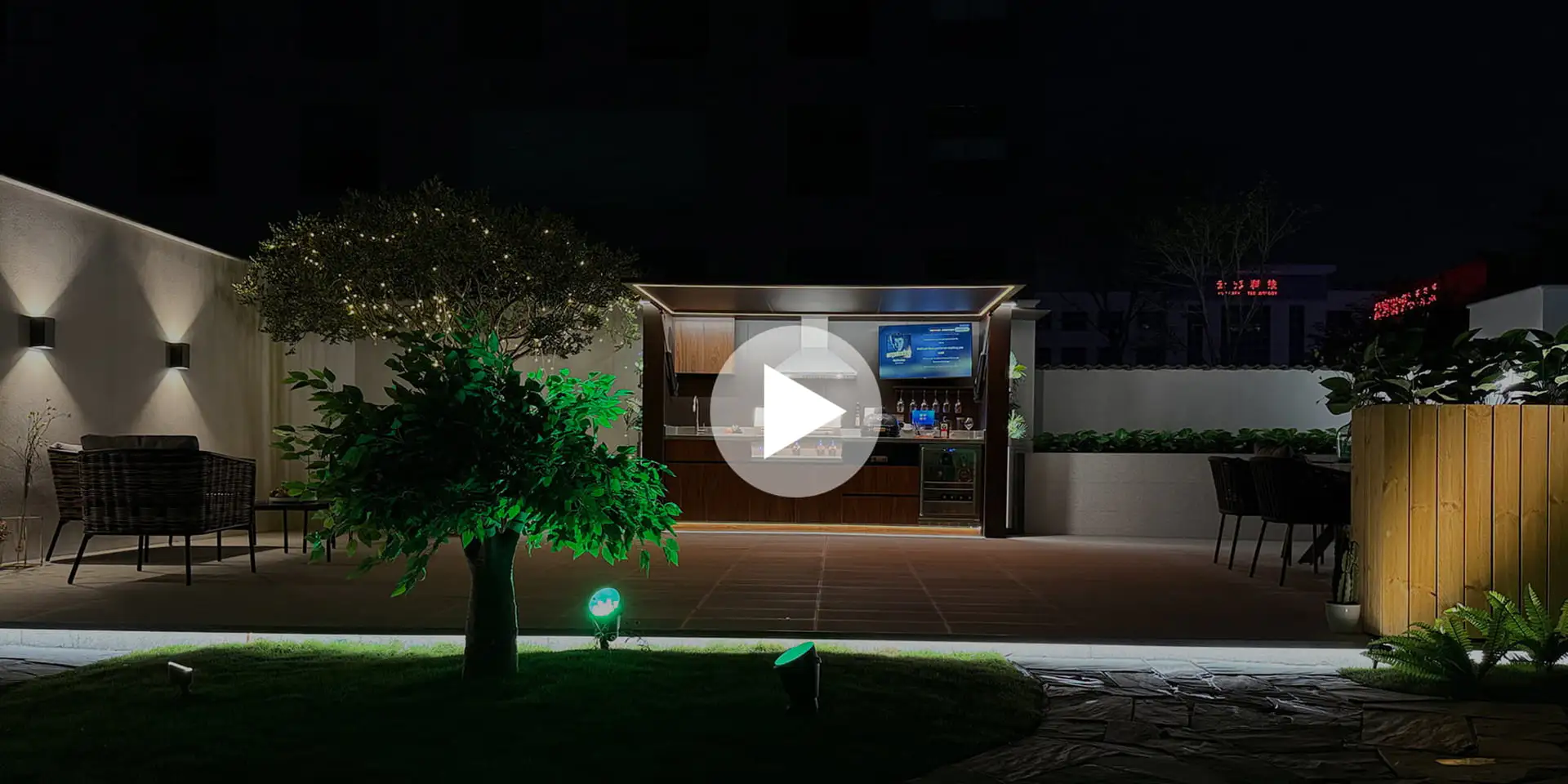 AFA A-Series Lift-Up Door BBQ PodIntegrated outdoor kitchen pod with lift-up door, 304 stainless steel, built-in grill, kamado, hood, and fridge; protects the cooking station from rain and dust.View Product →
An enclosure also changes the specification of everything inside it. Because the grill and the worktop stay dry, surfaces stay cleaner for longer and hardware lasts through more seasons. Decide the door type before you decide the cabinet run, since the enclosure dictates where the frame posts sit and how much elbow room the cook has when the door is open.
Layout Shapes and What Each One Costs in Counter Space
Layout determines how many metres of stainless you pay for and how pleasant the kitchen is to use at seven in the evening with a tray of food in your hands. Five shapes cover nearly every residential project.
| Layout | Typical run | Suits | Trade-off |
|---|---|---|---|
| Linear | 2.4-3.6 m against a wall or fence | Narrow patios and side yards | Cheapest and simplest, but the longest walking distance |
| L-shaped | Two runs meeting at a corner | Courtyard gardens and standard terraces | Corner unit adds storage; watch elbow room at the turn |
| U-shaped | Three sides, 1.8-2.4 m clear inside | Dedicated cooking and prep zones | Best work triangle; needs a wider footprint |
| G-shaped | U-shape plus a peninsula | Large gardens and entertaining areas | Peninsula doubles as a bar; check circulation |
| Diamond | Angled corner modules | Awkward corners and poolside decks | Recovers dead corner space; needs custom cut angles |
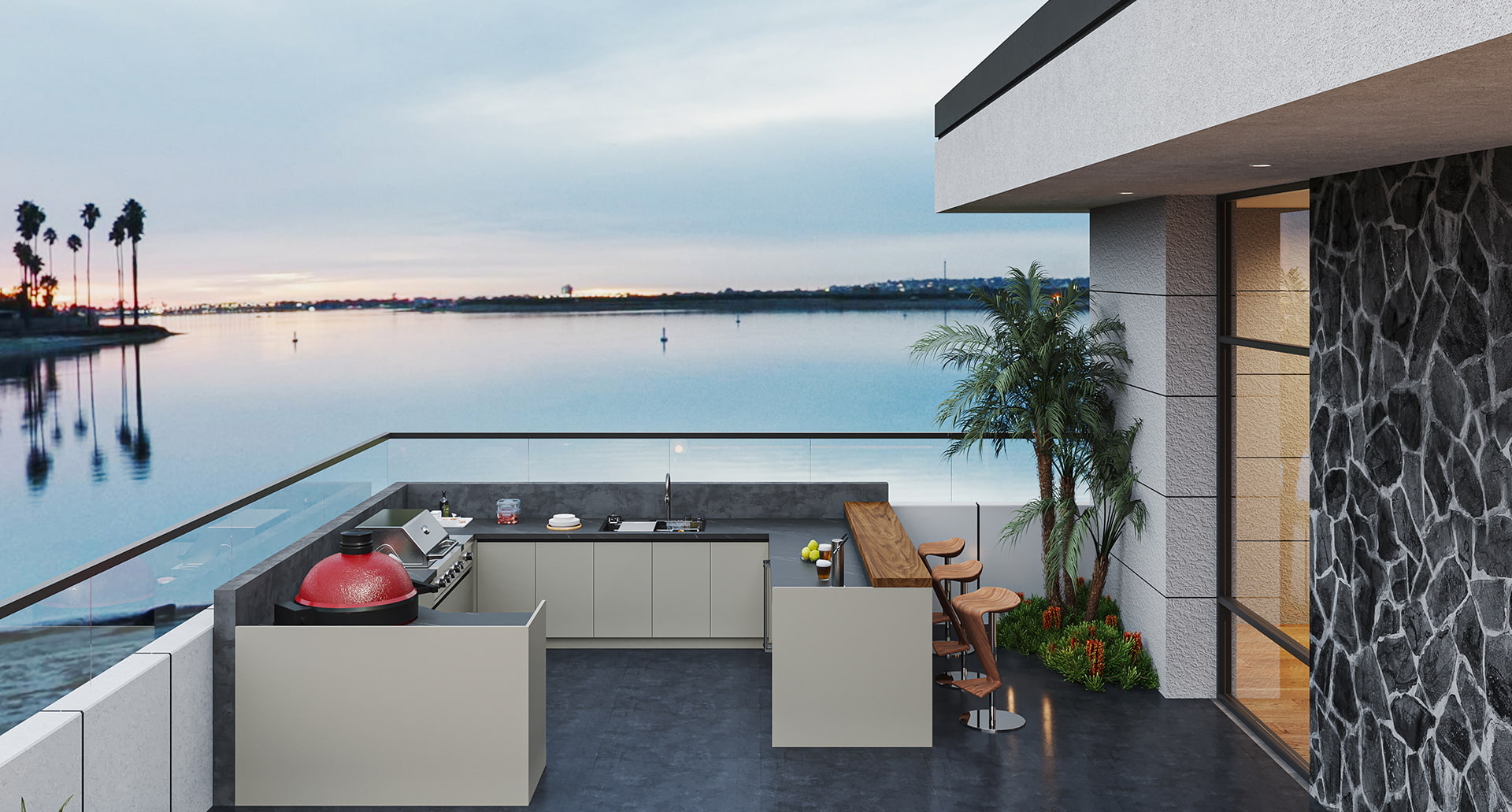 AFA U-Shaped Outdoor Kitchen CabinetsU-shaped layout for large patios with function display on both sides, allowing cooks to move easily between work zones and optimize grilling workflow.View Product →
The rule that matters more than any drawing: lay out the walking path first, then place cabinets around it. A U-shaped kitchen with 1.2 m of clear space inside looks generous on a plan and feels cramped the first time two people cook together.
Grill, Cart and Storage Sizing
Built-in grills are sized in inches, and that number should follow the guest list rather than the length of the countertop.
- 30-inch: two to four people, occasional cooking.
- 36-inch: the most common choice for family use and regular weekend entertaining.
- 42-inch: larger households that cook for guests frequently.
- 46-inch: villa kitchens and light commercial use.
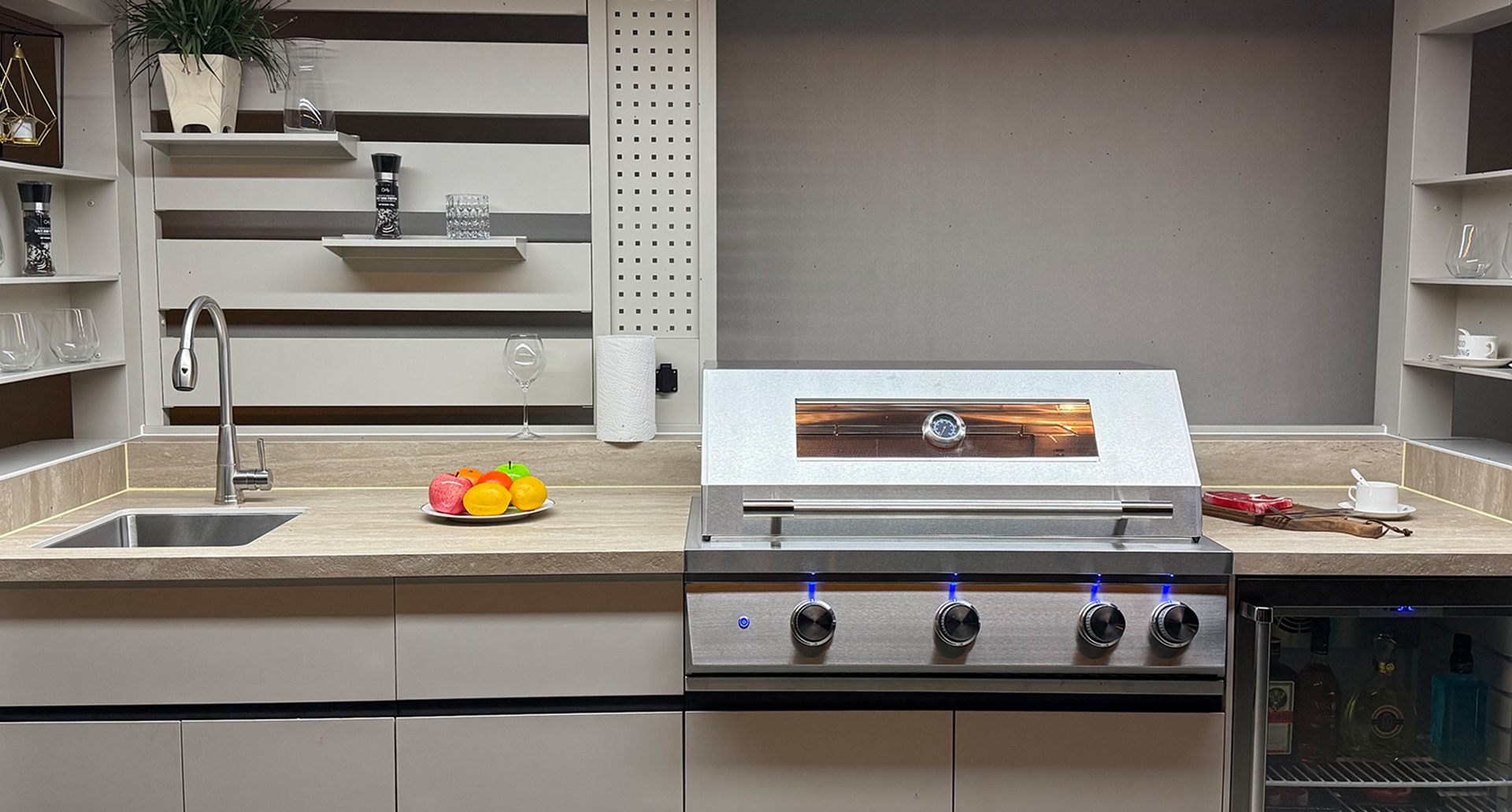
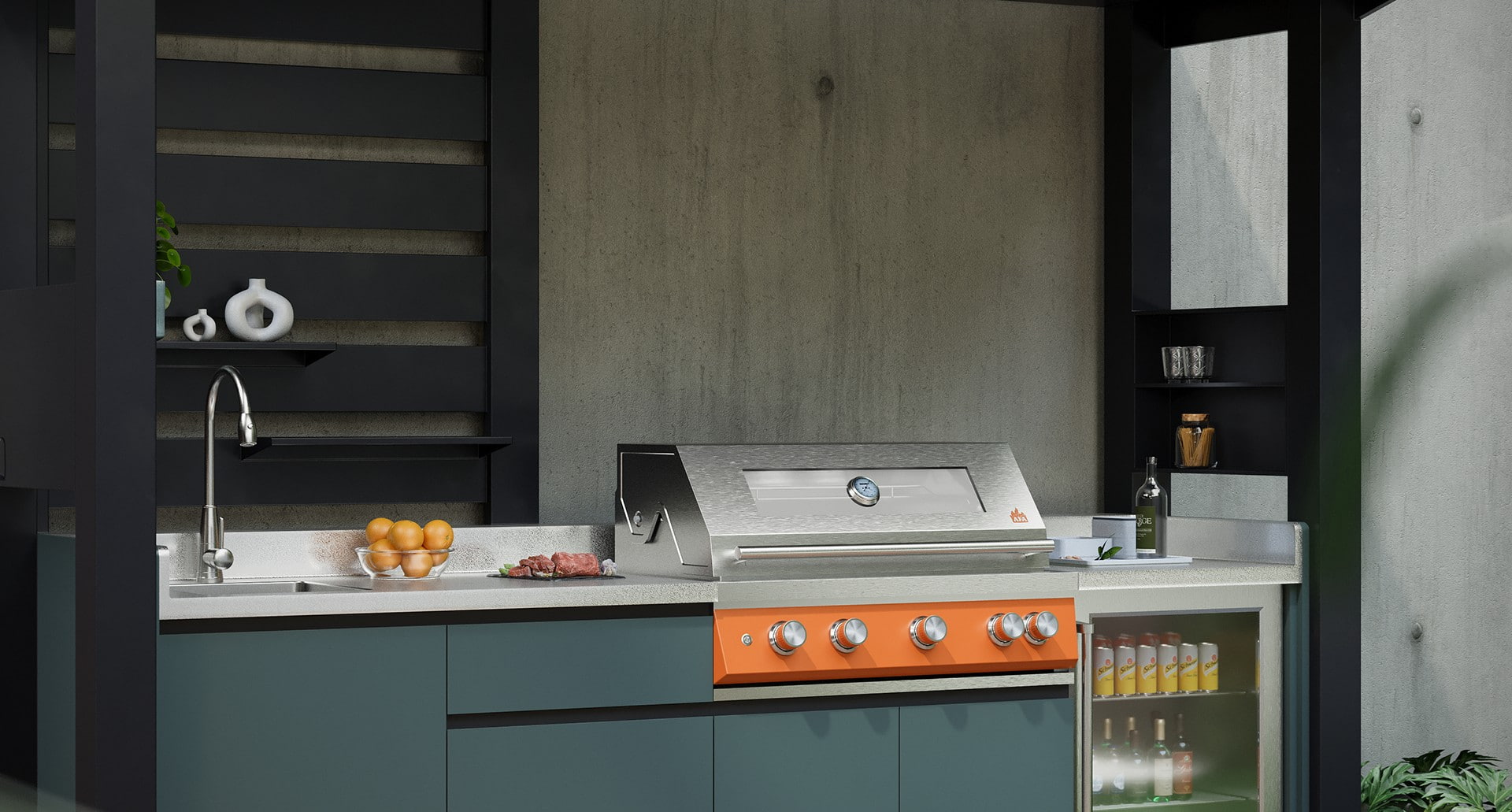 36-Inch Built In BBQ Grill304 stainless steel built-in grill with three U-shaped racks, extra racks, rear grill function, and a rotisserie kit for roasting larger cuts.View Product →
Cutout tolerance deserves to be agreed in writing. A grill rated for a nominal cutout can move by 1.5 mm either way, and a stone fabricator who never receives the grill drawing will cut to the millimetre. Check countertop depth, which is typically 600-650 mm, plus rear clearance for a hood and the route of the gas line before the carcasses are fixed in place.
Freestanding carts at 36 and 42 inches cover the projects where the grill has to move, such as rental properties, event catering, or a courtyard with no permission for a permanent structure. For storage, tool cabinets scale neatly: GTC1 is a single-door unit for a small accessory set, GTC2 is a double-door cabinet for standard outdoor kitchen storage, and GTC3 is a large three-door unit for cookware, covers and outdoor power equipment.
What to Verify Before the Container Ships
Most disputes on an outdoor kitchen order are not about design. They are about the gap between what was delivered and what was specified. A short verification list, agreed before production starts, prevents nearly all of them.
- Gauge readings taken with a micrometre on a finished door, not only on the raw coil certificate.
- Fastener and hinge grade confirmed in writing, with spare hinges included in the shipment.
- Passivation and finishing method for every visible weld.
- Salt-spray or humidity test reports where the destination is coastal.
- Cutout drawings signed off by the countertop fabricator.
- Corner protection, foam separation and pallet stacking suitable for 30 days of sea freight.
- Assembly instructions in the destination language, plus a spare-parts list.
AFA has been manufacturing stainless steel kitchen products since 1993, when the company began as a sink workshop in Yuyao, and now operates from three plants covering 45,000 square metres. The outdoor range covers BBQ pods, built-in grills, carts, kitchen cabinets and tool cabinets, with output going to the United States, Europe, Australia, the Middle East and other markets. Buyers who work through importers, retailers and project contractors can review the distribution and dealer programme for order terms and technical support.
If you are interested in our products, please contact us with your project drawings, grill size and preferred door system, or open the configurator to build a specification step by step: start your outdoor kitchen configuration.
Copyright © 2025 Ningbo AFA Kitchen and Bath Co.,Ltd. All Rights Reserved. Custom Modular Outdoor Kitchen Manufacturer Outdoor Barbecue (BBQ) Kitchen Factory Privacy Policy
