 English
 Español
 Deutsch
 Português
 italiano
 Français
 عربى
عربى
Search
News categories
Recommend News
News categories
Recommend News
 Sep 04, 2026 - By admin
Outdoor Cabinets for Patio: A Buyer's Guide to Stainless Steel Storage That Lasts
Sep 04, 2026 - By admin
Outdoor Cabinets for Patio: A Buyer's Guide to Stainless Steel Storage That Lasts
Content
- 1 Start With the Material: 304 Stainless vs. the Alternatives
- 2 Match the Cabinet Type to How You Use the Patio
- 3 Door Style Decides How Well the Cabinet Shrugs Off Weather
- 4 Sizing a Patio Cabinet: Measure the Space, Then the Gear
- 5 Storage Details That Matter Every Day
- 6 A Five-Point Checklist Before You Buy
A powder-coated steel cabinet that looks sharp on the showroom floor can show orange rust bleeding from every screw head after its first winter on an open patio. Outdoor cabinets face direct sun, driving rain, freeze-thaw cycles, and grease from the grill — a combination that wrecks indoor-grade materials within a season or two. So here is the short answer up front: for patio storage that still looks and performs in year five, choose 304 stainless steel, pick a door style that closes fully against the weather, and match the footprint to how you actually cook and entertain. The sections below walk through each of those decisions in practical terms.
Start With the Material: 304 Stainless vs. the Alternatives
Most cabinets marketed for outdoor use come in four materials: 304 stainless steel, powder-coated carbon steel, HDPE plastic, and wood or wood composite. Under a covered porch, all four can survive. On an exposed patio, the gap between them opens quickly.
304 stainless steel contains roughly 18% chromium and 8% nickel. The chromium reacts with oxygen to form a thin, invisible oxide film that continuously protects the steel and self-repairs after scratches — which is why a scuff on stainless stays cosmetic, while a chip in powder coating becomes the starting point of a rust streak. Coated steel only protects where the coating is intact. Wood swells at the joints as humidity swings and needs resealing almost every year, and HDPE shrugs off water but fades under UV and can flex in summer heat.
Two honest caveats. First, 304 is stain-resistant, not stain-proof: in coastal air, salt spray leaves tea-colored surface staining that wipes off with the right cleaner but should not be ignored. Second, panel thickness separates good cabinets from flimsy ones — press a door before buying, and if the sheet flexes and drums, it will not survive years of being shut with wet hands. If you have already spotted staining on a stainless cabinet at home, this guide to whether 304 stainless steel really rusts outdoors explains why it happens and how to deal with it.
Match the Cabinet Type to How You Use the Patio
"Outdoor cabinets for patio" covers three product families, and choosing wrong between them wastes more money than any material decision. Outdoor kitchen cabinets are modular runs with doors and drawers that form a fixed cooking and prep zone around a built-in grill. BBQ pods are self-contained enclosures that house the grill, work surface, and storage behind closable doors — the entire kitchen disappears from view when you are done. Multi-function tool cabinets are pure storage: no counter, no grill, just a dry, lockable home for tools, covers, and accessories.
The right choice depends on the role the patio plays. If you grill weekly and want counter space for prep and plating, build around kitchen cabinets. If the patio doubles as a visual space where you would rather not stare at grill grates all month, a pod hides everything behind one clean facade. If you only need somewhere dry to keep brushes, thermometers, and cushion bags, a tool cabinet solves it for the least money and floor space.
| Cabinet Type | Best For | Access Style | Weather Tolerance |
|---|---|---|---|
| Outdoor kitchen cabinets | Fixed cooking and prep zone around a built-in grill | Hinged doors and drawers under an open counter | Good; pair with an overhead cover for the longest life |
| BBQ pod (shutter or blind) | All-in-one cooking that can be sealed shut between uses | Roller shutter or roller blind closing over the full front | Excellent when closed; the shutter seals tightest |
| Pavilion-style pod | Social cooking under a permanent roof | Open sides beneath a canopy | Roof shielding only; treat it as a covered station |
| Multi-function tool cabinet | Dry storage for tools, covers, and accessories | One to three hinged doors | Good; position away from sprinklers and runoff |
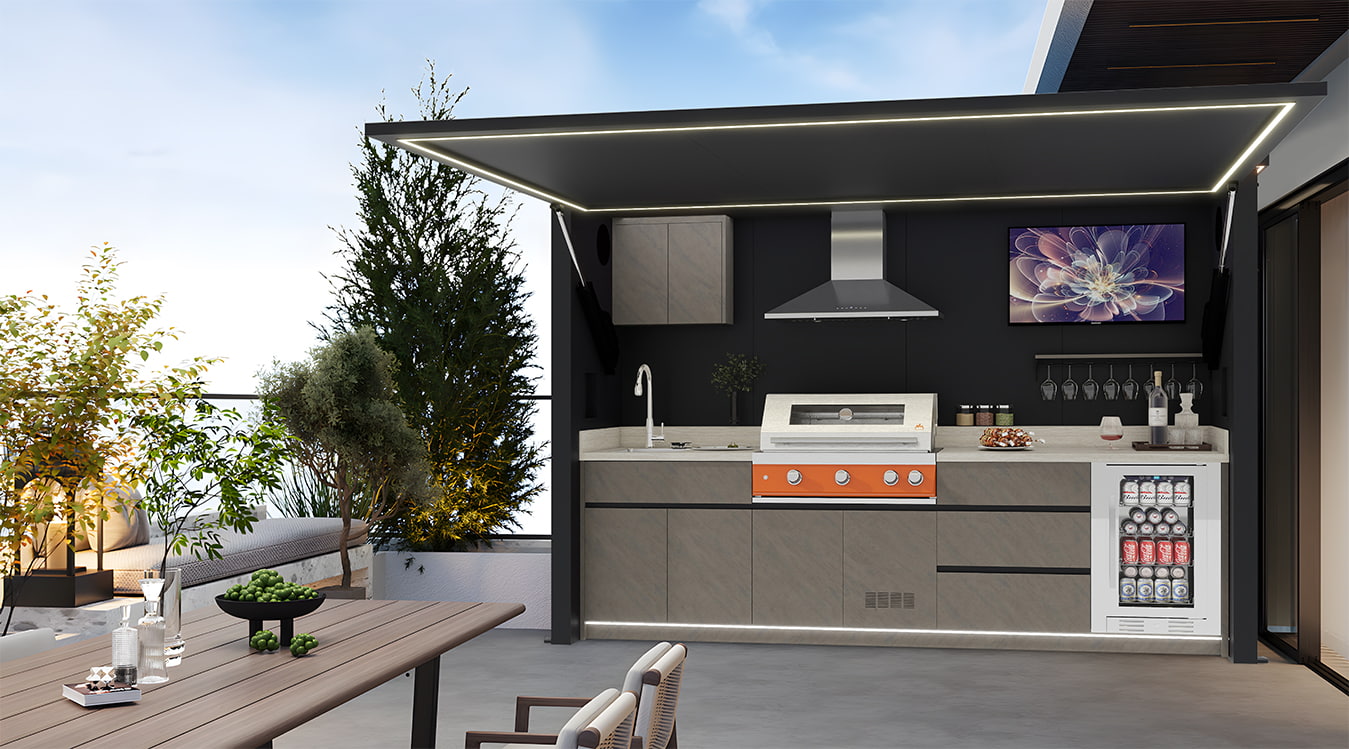
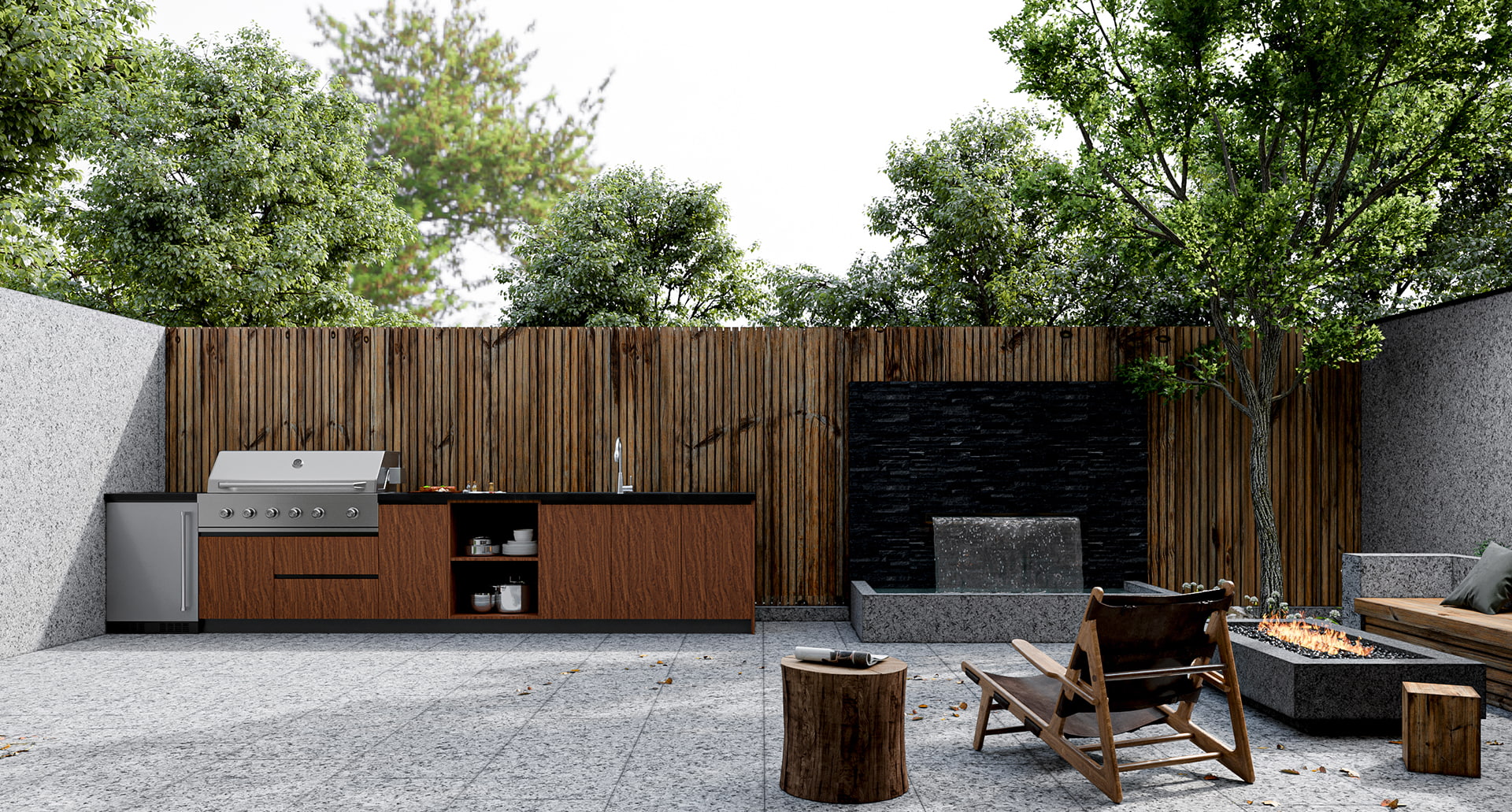 Linear Outdoor Kitchen Cabinets for Straight Patio RunsA single-row cabinet layout fits narrow patios and short walls, keeping the grilling workflow simple while preserving floor space. Worth a look if you grill weekly and want real counter space for prep and plating.View Product →
Linear, L-Shaped, or U-Shaped?
On a narrow patio or a wall shorter than about three meters, a linear run keeps the workflow simple and leaves floor space for seating. An L-shaped layout wraps a corner, separating the wet zone from the grill zone and giving two people room to work without colliding. U-shaped and G-shaped layouts suit larger decks where the outdoor kitchen becomes the actual hub of entertaining rather than an annex to the indoor one.
Door Style Decides How Well the Cabinet Shrugs Off Weather
Door hardware is where patio cabinets quietly succeed or fail, because the door is the only moving and only partially sealed part of the whole unit. Four styles dominate. A lift-up door swings upward on struts, so the open door doubles as a rain canopy while you cook. A roller shutter is a curtain of interlocking slats that rolls down to close the entire front — the tightest seal against rain, dust, wind-blown leaves, and curious animals, which makes it the safest choice for a fully exposed cabinet. A roller blind drops a single panel over the opening, a simpler mechanism with a flat, clean face. A pavilion-style unit keeps an open front under a permanent roof, prioritizing airflow and social visibility over sealing.
One practical rule: if the cabinet lives under a covered patio, all four styles work and you can choose on looks. If it stands in the open, prioritize the shutter or the blind, and check how the top edge sheds water. Tracks that hold standing water are the number one failure point on rolling doors, so ask where the drain holes are positioned before you commit.
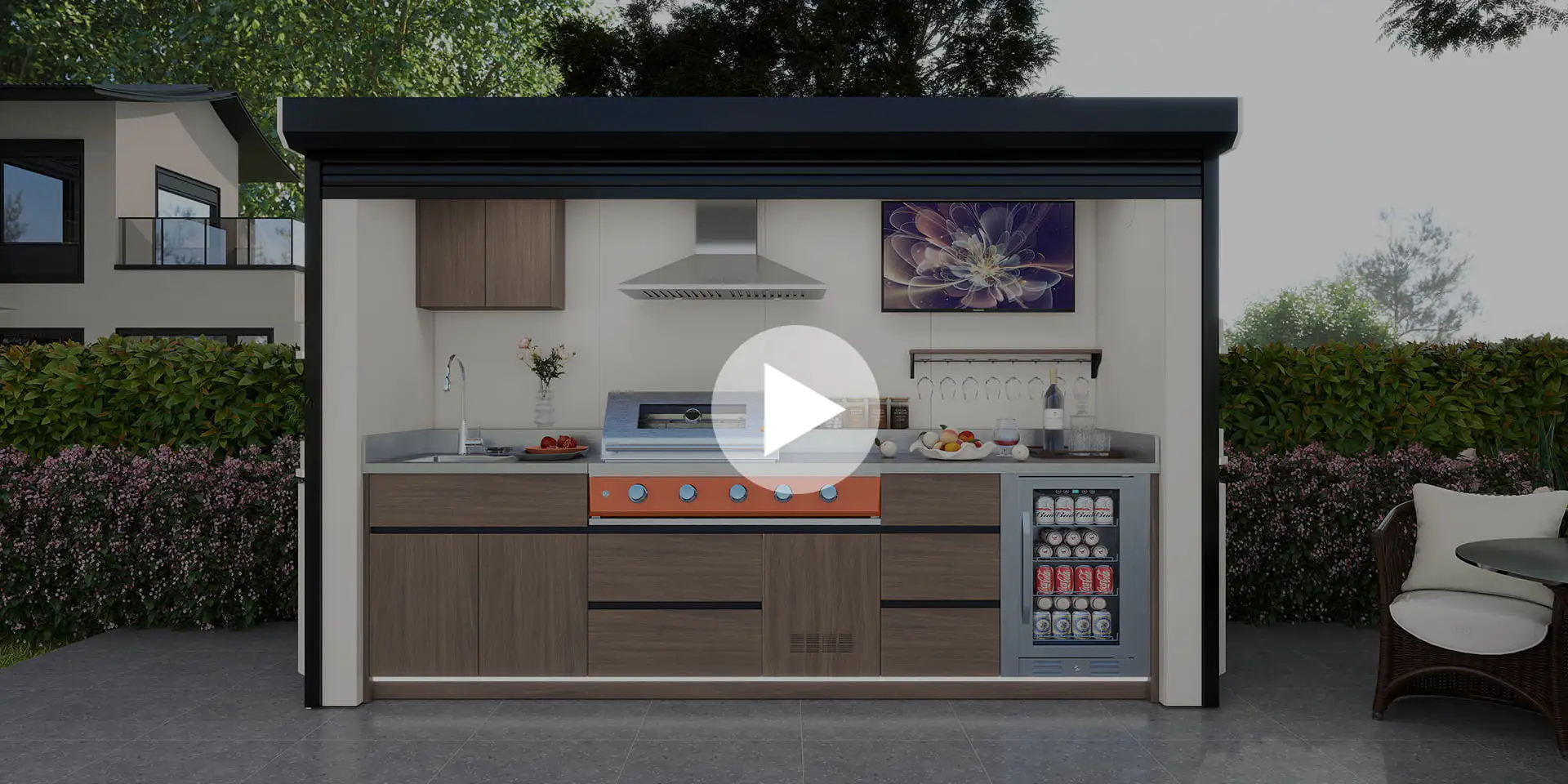 Roller Shutter BBQ Pod for Covered Outdoor KitchensA pod conceals the grill behind one clean facade, ideal for patios where looks matter. Rolling shutter doors suit covered areas, and checking how the top edge sheds water helps in open placements.View Product →
Sizing a Patio Cabinet: Measure the Space, Then the Gear
Most outdoor kitchen modules follow interior-kitchen ergonomics: roughly 24 inches (about 610 mm) deep and 36 inches (about 915 mm) high at the counter. Confirm the exact figures on the spec sheet rather than assuming, because depths vary by model and a shallow cabinet may not accept a built-in grill at all.
The measurement that actually costs people money is the grill cutout. Built-in grills commonly come in 30, 36, 42, and 46-inch widths, and each model has a manufacturer-specified cutout dimension that differs from its nominal width. The cabinet opening must match that number exactly — ordering cabinets before you have the grill's cutout spec is the most expensive mistake in this category, and the reason installers beg customers to pick appliances first.
Clearances and Utilities
Keep at least 36 inches of clear floor in front of the run, closer to 48 inches where two people will work side by side or where the walkway leads to the house door. Mark the positions of the gas line, electrical outlets, and any water connection before finalizing the layout — moving a service after the cabinets arrive costs far more than shifting the plan on paper. Finally, check the floor itself: pavers and decking rarely sit perfectly level, so adjustable leveling feet under each module keep counter joints tight and doors swinging true.
Storage Details That Matter Every Day
Capacity on a spec sheet tells you little; what matters is how the interior is divided. Look for at least one adjustable shelf so a stack of grill grates or a bag of charcoal can fit, a removable or rinsable bottom tray, and handles a wet or gloved hand can actually grip. For standalone storage, dedicated tool cabinets come in graduated sizes — a compact single-door unit holds brushes and thermometers, a double-door cabinet absorbs the average grill's full accessory set, and a large three-door unit takes cookware, serving trays, and even a compact outdoor power station.
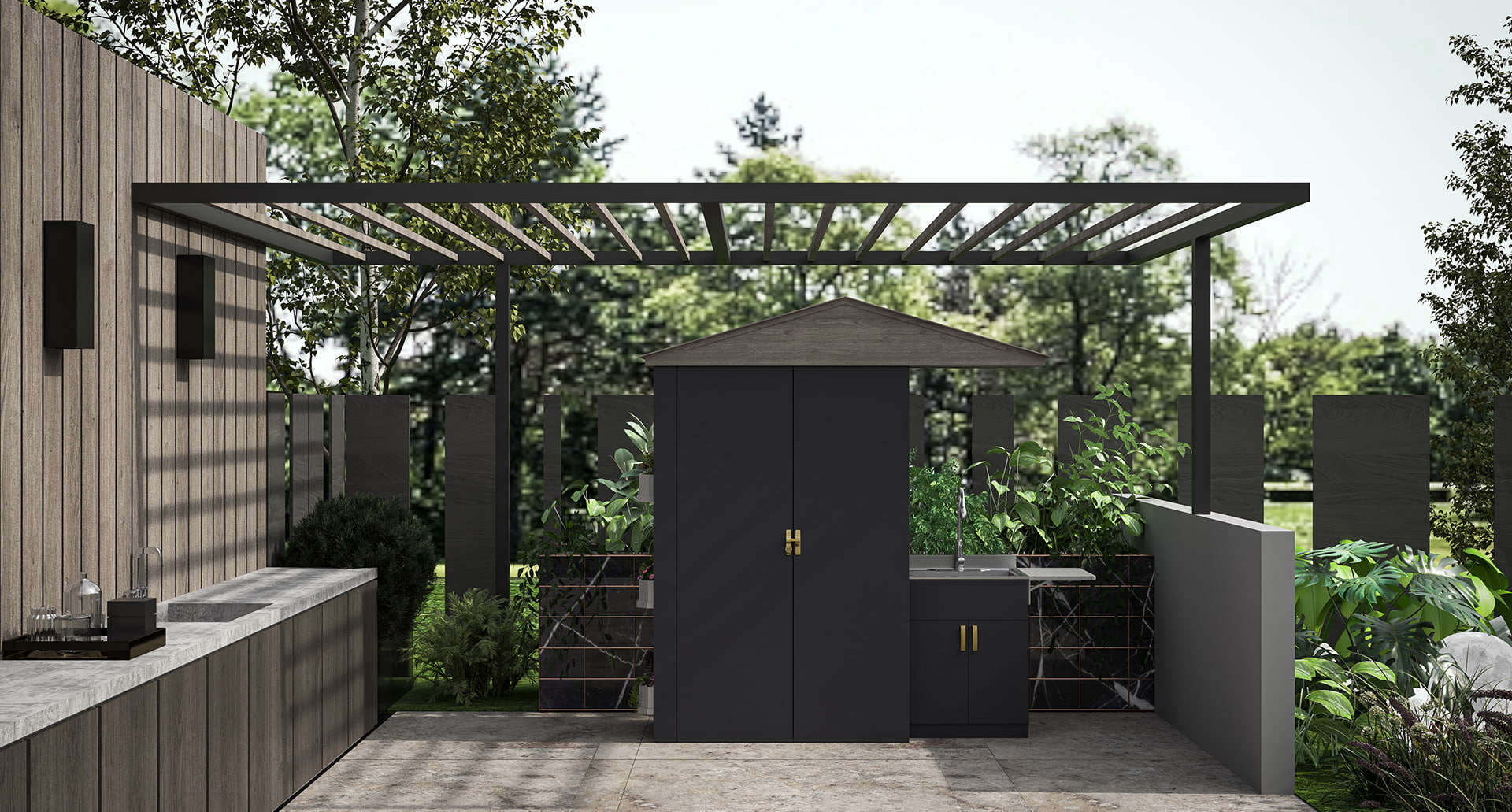 G-TC2 Double-Door Outdoor Multi-Function Tool CabinetA double-door unit sized to absorb a typical grill's full accessory set. Look for adjustable shelves, a removable bottom tray, and grippable handles when deciding which tool cabinet capacity fits your storage needs.View Product →
One safety note worth repeating: never park a connected propane cylinder inside a fully sealed cabinet. Store the tank in a ventilated compartment designed for it, or outside the cabinet altogether, and follow the clearance rules in your local gas code — sealed cabinetry and a leaking fitting are a genuinely dangerous combination.
A Five-Point Checklist Before You Buy
Take this list to the showroom or the spec sheet. Every point here has ended someone's enjoyment of an otherwise good cabinet.
- Ask for the grade in writing. You want 304 (18/8) stainless for the body and doors, not an unspecified "stainless steel" that may turn out to be a cheaper 400-series sheet.
- Check panel thickness and rigidity. Press the door panel and the sides; sheet that flexes and drums will dent and look tired within a year.
- Look for water management. Sloped tops, gasketed or overlapping doors, and drain holes in any track decide whether water leaves the cabinet or lives in it.
- Verify the hardware grade. Hinges, handles, and screws should be stainless too — plated zinc hardware is always the first thing to rust, and it stains the panels around it.
- Confirm after-sales support. Spare parts availability, warranty terms, and a distributor who answers the phone matter more on a product that ships in a crate and lives outdoors.
Work through the five points in order and any candidate either passes cleanly or reveals exactly where its corners were cut.
If you are interested in adding stainless steel cabinets to your patio, we would be glad to help. AFA has manufactured stainless steel kitchen and outdoor products since 1993, running three production bases that cover 45,000 square meters, and the configurator on our site lets you match door style, series, and size to your space. Contact us with your patio dimensions and how you like to cook — or open the configurator and start specifying your outdoor setup today.
Copyright © 2025 Ningbo AFA Kitchen and Bath Co.,Ltd. All Rights Reserved. Custom Modular Outdoor Kitchen Manufacturer Outdoor Barbecue (BBQ) Kitchen Factory Privacy Policy
