 English
 Español
 Deutsch
 Português
 italiano
 Français
 عربى
عربى
Search
News categories
Recommend News
News categories
Recommend News
 Jul 17, 2026 - By admin
Does 304 Stainless Steel Rust? What Outdoor Cabinets Owners Should Know
Jul 17, 2026 - By admin
Does 304 Stainless Steel Rust? What Outdoor Cabinets Owners Should Know
Content
- 1 Quick Answer: Does 304 Stainless Steel Rust?
- 2 Why 304 Stainless Steel Resists Rust in the First Place
- 3 When 304 Stainless Steel Can Still Show Surface Issues
- 4 304 vs. 316 Stainless Steel for Outdoor Kitchen Cabinets
- 5 Telling Surface Staining Apart From Structural Rust
- 6 Maintaining Outdoor Kitchen Cabinets to Prevent Surface Rust
- 7 Choosing a Reliable Outdoor Kitchen Cabinets Manufacturer
Quick Answer: Does 304 Stainless Steel Rust?
304 stainless steel does not rust under normal conditions, and this is exactly why it's the standard material for quality Outdoor Kitchen Cabinets. Its resistance comes from a chromium content of roughly 18%, which forms a thin, self-repairing chromium oxide layer on the surface that shields the underlying metal from oxygen and moisture. That said, 304 stainless steel is not entirely immune to every form of corrosion — in coastal environments with high airborne salt content, or where the surface is regularly exposed to chlorine, road salt, or embedded contamination from carbon steel tools, it can develop light surface staining or pitting over time, even though the metal itself is not rusting the way ordinary steel would. The sections below explain why 304 behaves this way, when it can still show surface issues, how it compares to 316 stainless steel for harsher climates, and how to keep outdoor cabinetry looking new for years.
Why 304 Stainless Steel Resists Rust in the First Place
Rust, technically iron oxide, forms when iron in ordinary steel reacts with oxygen and moisture over time. 304 stainless steel avoids this because it is an alloy containing roughly 18% chromium and 8% nickel alongside iron, and the chromium reacts with oxygen in the air to form an extremely thin, transparent layer of chromium oxide on the surface. This passive layer is only a few nanometers thick, but it is remarkably effective at blocking further oxygen and moisture from reaching the iron underneath.
The Self-Healing Property
What makes this protective layer especially useful for Outdoor Kitchen Cabinets is that it is self-healing. If the surface is scratched or scuffed during daily use, the exposed chromium reacts with oxygen almost immediately to rebuild the protective layer, which is why 304 stainless steel continues resisting corrosion even after years of scrapes from cookware, utensils, and general outdoor wear.
When 304 Stainless Steel Can Still Show Surface Issues
The passive layer on 304 stainless steel is strong but not indestructible. In specific conditions, it can be overwhelmed faster than it can repair itself, leading to surface discoloration or light pitting that some people mistake for true rust.
- Chloride exposure from ocean air or pool chemicals can break down the passive layer faster than it regenerates, particularly on Outdoor Kitchen Cabinets installed within a few hundred meters of the coastline.
- Embedded particles from carbon steel tools, wire brushes, or steel wool can lodge in the surface and rust on their own, creating small rust spots that look like the stainless steel itself has corroded.
- Prolonged standing water or debris left on a horizontal surface can create a localized environment where oxygen can't reach the metal evenly, slowing the passive layer's ability to repair itself in that specific spot.
- Heat discoloration near a grill or heat source can sometimes be mistaken for rust, though this is typically a surface oxidation color change rather than true corrosion.
304 vs. 316 Stainless Steel for Outdoor Kitchen Cabinets
For most residential settings, 304 stainless steel provides more than enough corrosion resistance for Outdoor Kitchen Cabinets. In coastal or high-chloride environments, however, 316 stainless steel is often the better choice due to its added molybdenum content, which further strengthens the passive layer against chloride attack.
| Property | 304 Stainless Steel | 316 Stainless Steel |
|---|---|---|
| Chromium content | Around 18% | Around 16-18% |
| Molybdenum content | None | Around 2-3% |
| Best suited environment | Inland and general residential outdoor use | Coastal, poolside, or high-chloride settings |
| Relative cost | Lower | Higher |
For a backyard well away from the coast, 304 stainless steel remains a practical, cost-effective choice for Outdoor Kitchen Cabinets, since the added chloride resistance of 316 becomes less relevant without regular salt air exposure.
Telling Surface Staining Apart From Structural Rust
Not every mark on a stainless steel cabinet means the same thing, and knowing the difference helps decide whether a simple cleaning will fix it or whether the material itself has been compromised.
- Light orange or brown surface discoloration that wipes away with a stainless steel cleaner is usually contamination from embedded iron particles, not true corrosion of the stainless steel itself.
- Small, scattered pinpoint rust spots that return after cleaning may indicate contamination is trapped below the surface, requiring a more thorough passivation treatment to fully resolve.
- Deep pitting or corrosion that doesn't respond to cleaning at all is a more serious sign, often linked to prolonged chloride exposure in a coastal setting without adequate maintenance.
Maintaining Outdoor Kitchen Cabinets to Prevent Surface Rust
Good maintenance habits make a meaningful difference in how well 304 stainless steel Outdoor Kitchen Cabinets hold their appearance over years of outdoor exposure.
- Wipe down surfaces regularly with a mild soap and water solution, always working in the direction of the metal's grain rather than across it.
- Rinse off salt spray, pool chemical residue, or food acid promptly rather than letting it sit on the surface for extended periods.
- Avoid cleaning with steel wool, wire brushes, or abrasive pads made from carbon steel, since these can embed tiny iron particles that later rust on the surface.
- Apply a stainless steel polish or protective coating periodically in coastal areas to reinforce the passive layer against chloride exposure.
Choosing a Reliable Outdoor Kitchen Cabinets Manufacturer
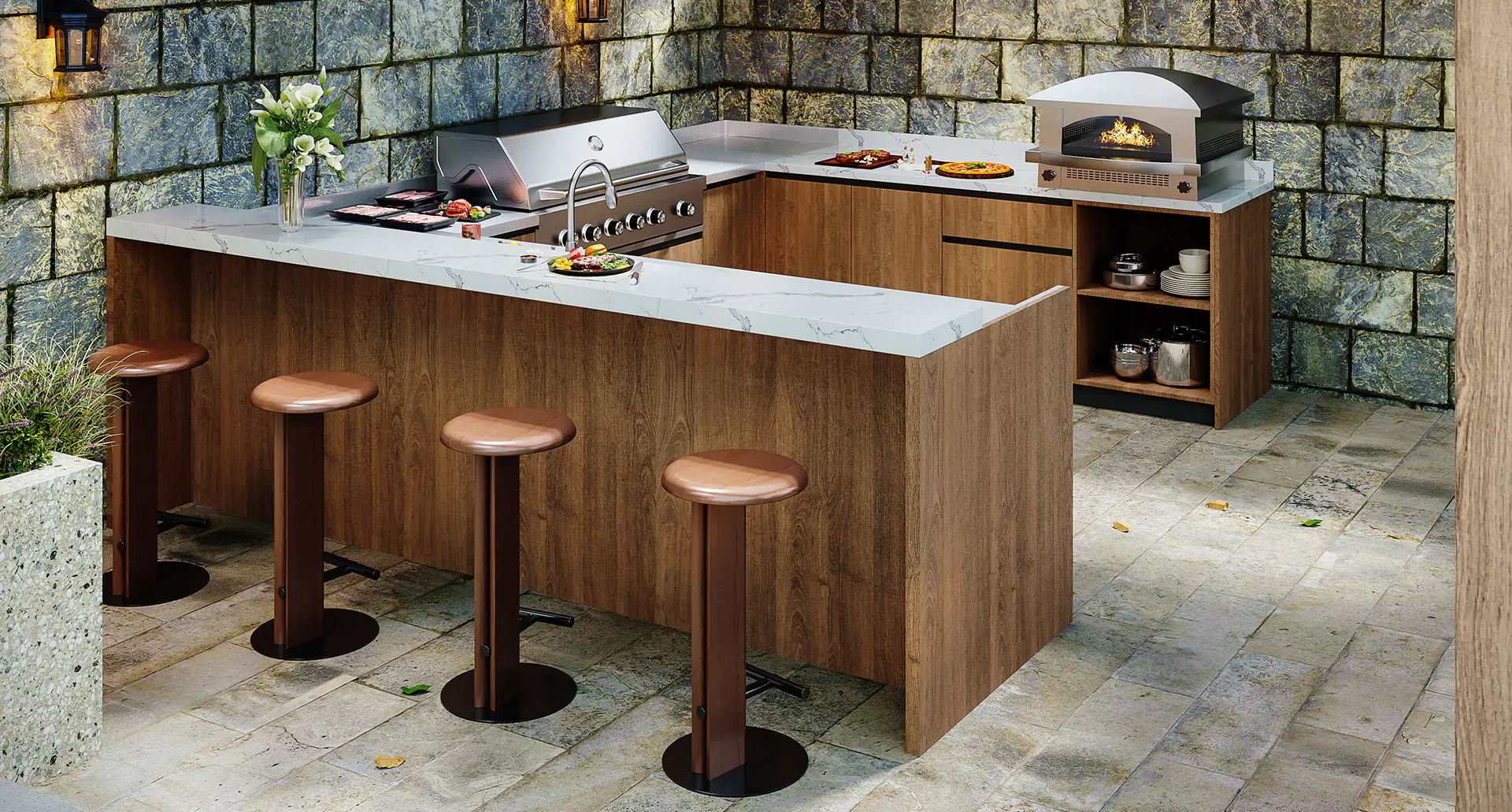
Ningbo AFA Kitchen & Bath Co., Ltd. has manufactured stainless steel cabinetry since 1993, building its Outdoor Kitchen Cabinets range from food-grade SUS304 stainless steel with a plate thickness typically between 0.91mm and 1.5mm, across three production bases covering 45,000 square meters. The company's outdoor kitchen cabinets are available in linear, L-shaped, diamond-shaped, U-shaped, and G-shaped configurations, with countertop options in stainless steel or sintered stone, and quality verified through in-house laboratory testing before products ship to clients across the United States, Europe, Australia, and other markets.
For homeowners near the coast or around a pool, discussing grade selection between 304 and 316 stainless steel with the manufacturer before ordering Outdoor Kitchen Cabinets is a practical step toward ensuring the cabinetry performs well in the specific climate it will actually be installed in, rather than assuming one grade fits every environment equally.
For more information about our products, solutions, or cooperation opportunities, please feel free to contact us./optional/
Copyright © 2025 Ningbo AFA Kitchen and Bath Co.,Ltd. All Rights Reserved. Custom Modular Outdoor Kitchen Manufacturer Outdoor Barbecue (BBQ) Kitchen Factory Privacy Policy
