 English
 Español
 Deutsch
 Português
 italiano
 Français
 عربى
عربى
Search
News categories
Recommend News
News categories
Recommend News
 Jun 17, 2026 - By admin
How to Create an Outdoor BBQ Kitchen Pod in a Small Backyard
Jun 17, 2026 - By admin
How to Create an Outdoor BBQ Kitchen Pod in a Small Backyard
Content
- 1 The Smartest Answer for Small Backyards: Choose a Compact Outdoor BBQ Kitchen Pod
- 2 What Is an Outdoor BBQ Kitchen Pod?
- 3 Step 1 — Measure Your Small Backyard and Identify the Ideal Pod Zone
- 4 Step 2 — Choose the Right BBQ Kitchen Pod Configuration for Your Space
- 5 Step 3 — Select the Core Components of Your Outdoor BBQ Kitchen Pod
- 6 Step 4 — Plan the Layout Around Your Small Backyard's Natural Flow
- 7 Step 5 — Prepare the Base and Utility Connections
- 8 Step 6 — Customize Your Outdoor BBQ Kitchen Pod for Your Lifestyle
- 9 Material Quality: Why 304 Stainless Steel Is the Standard for Outdoor BBQ Pods
- 10 Small Backyard BBQ Kitchen Pod: Design Tips to Maximise the Space
- 11 Why AFA Stainless Outdoor BBQ Kitchen Pods Are Built for Residential Backyards
The Smartest Answer for Small Backyards: Choose a Compact Outdoor BBQ Kitchen Pod
If you have a small backyard and dream of a fully functional outdoor cooking space, an outdoor BBQ kitchen pod is your most practical and cost-effective solution. Rather than committing to an expensive custom-built structure that can cost $15,000–$60,000 or more, a prefabricated BBQ kitchen pod delivers a complete, weatherproof outdoor kitchen — grill, countertop, sink, storage, and lighting — in a self-contained unit that fits spaces as narrow as 3 meters wide.
The key principle is this: plan your pod layout first, then fit it to your available footprint, not the other way around. A modular outdoor BBQ kitchen pod from a manufacturer like AFA Stainless (Ningbo AFA Kitchen & Bath Co., Ltd.) gives you the flexibility to configure dimensions, appliances, and features to match your exact backyard dimensions without sacrificing functionality.
What Is an Outdoor BBQ Kitchen Pod?
An outdoor BBQ kitchen pod is a pre-assembled or ready-to-assemble modular outdoor kitchen unit that combines a BBQ grill, preparation countertop, storage cabinets, and often a sink into a single weatherproof enclosure. Unlike traditional outdoor kitchens that require contractors, concrete work, and months of construction, a BBQ pod arrives largely ready to use — dramatically reducing both installation time and labor cost.
The structure is typically built from 304-grade stainless steel or high-grade aluminum, materials chosen specifically because they resist rust, UV exposure, salt spray, temperature extremes, and moisture without warping or degrading. Modern pods also integrate features such as remote-controlled canopy doors, LED lighting systems, built-in refrigeration, and smart storage solutions.
According to industry analysis, the global outdoor kitchen market reached $24.45 billion in 2024 and is projected to grow at a 9.1% CAGR to $52.75 billion by 2033, with North America accounting for nearly 47% of that share — a clear indicator of surging homeowner demand for premium outdoor cooking spaces.
| Option | Typical Cost Range | Installation Time | Small Backyard Suitability |
|---|---|---|---|
| Custom-Built Outdoor Kitchen | $15,000 – $60,000+ | 8–16 weeks | Limited — requires planning permissions |
| Entry-Level Modular Island | $2,000 – $5,000 | 1–2 days | Good — but limited features |
| Mid-Range BBQ Kitchen Pod | $5,000 – $15,000 | 1–3 days | Excellent — compact, fully featured |
| Premium Enclosed BBQ Pod | $15,000 – $40,000+ | 1–5 days | Excellent — with custom sizing |
Step 1 — Measure Your Small Backyard and Identify the Ideal Pod Zone
Before selecting any outdoor BBQ kitchen pod model, spend time measuring and assessing your available outdoor space. In a small backyard, every square meter matters. The goal is to identify a dedicated "pod zone" — a flat, stable surface close to your home's utility connections — without compromising access, airflow, or usable leisure space.
Key measurements to take
- Overall backyard dimensions (length × width)
- Distance from the back door or patio to the intended pod location
- Location of existing gas lines, water supply points, and electrical outlets
- Overhead clearance, especially under pergolas, eaves, or low branches
- Prevailing wind direction (position the grill downwind of seating areas)
Many compact outdoor BBQ kitchen pods start from as little as 1.5m × 0.9m (L×D) for a mini configuration, making them genuinely viable even in courtyards and terraced house gardens. A good rule of thumb: leave at least 90cm of clearance on each open side of the pod for safe circulation and ventilation.
Step 2 — Choose the Right BBQ Kitchen Pod Configuration for Your Space
Modern outdoor BBQ pods come in several structural configurations. Choosing the right one for a small backyard depends on your climate, how much weather protection you need, and whether you want a year-round cooking setup or a seasonal one.
Open-Air Pod
A minimalist frame with no roof or enclosure — ideal if your backyard is already under a pergola or covered patio. It provides the full kitchen island functionality with the smallest physical footprint. Best for warmer, drier climates.
Roof-Only Pod
A cantilevered steel or aluminium roof is added above the cooking zone to provide shade and light rain protection. This strikes a practical balance for most temperate climates without closing off the open-air feel of the backyard.
Fully Enclosed BBQ Pod
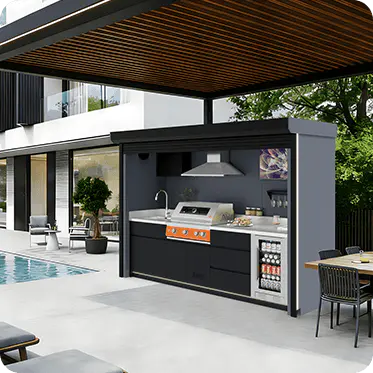
Features a remote-controlled motorized canopy door that seals the entire unit when not in use. This protects all appliances and cabinetry from heavy rain, frost, wind, and dust year-round. For small UK, Northern European, or coastal backyards, this is often the most pragmatic long-term investment. Units like this typically feature 6-layer insulated door panels and fully sealed electronics for all-weather durability.
AFA Stainless, founded in 1993 and operating three advanced production bases covering 45,000 square meters, specializes in precisely this category — outdoor intelligent BBQ pods built from precision-manufactured stainless steel that serve homeowners across the US, Europe, Australia, and beyond.
Step 3 — Select the Core Components of Your Outdoor BBQ Kitchen Pod
A well-specified outdoor BBQ kitchen pod for a small backyard should prioritize multi-functionality over size. Every component should earn its place. Here are the essential elements to configure:
The BBQ Grill
Built-in gas grills ranging from 30 inches to 46 inches are the most common choice for residential pods. A 30-inch, 4-burner gas grill provides sufficient cooking capacity for a family of 6 without dominating the pod's footprint. For smaller setups, a 2-burner configuration may be more appropriate. Charcoal or pellet options are available for those who prioritize flavour over convenience.
Stainless Steel Countertop and Prep Space
304-grade stainless steel countertops are the professional standard for outdoor kitchens. They are non-porous, heat-resistant, corrosion-resistant, and easy to clean after cooking — critical qualities for an outdoor environment. Sintered stone is a premium alternative that offers a more decorative finish with comparable durability.
Integrated Sink and Faucet
An integrated stainless steel sink transforms a BBQ station into a complete outdoor kitchen. It allows food preparation, handwashing, and cleanup without needing to return indoors. For small backyards, connecting to an existing outdoor cold-water tap is usually sufficient; hot water plumbing is an optional upgrade.
Storage Cabinets and Drawers
Weatherproof stainless steel drawers and access doors keep utensils, fuel, and accessories organized and protected. A well-designed pod should include a combination of deep storage drawers, pull-out trash units, and dedicated spaces for gas cylinder or fuel storage, all with soft-close mechanisms for daily convenience.
Integrated Refrigerator
A compact outdoor-rated refrigerator (typically 21 to 24 inches wide) keeps beverages and marinades chilled without the need for a separate cool box. This is especially valuable in a small backyard where patio space is limited.
LED Lighting
Integrated LED strip or ambient lighting extends the usable hours of your outdoor BBQ kitchen pod into the evening. Waterproof LED systems built into the canopy and under-counter zones create both functional task lighting and atmospheric mood lighting for entertaining.
Step 4 — Plan the Layout Around Your Small Backyard's Natural Flow
In a compact outdoor space, the placement of your BBQ kitchen pod directly affects how the rest of the backyard functions. Poor positioning can block natural pathways, create dangerous heat or smoke zones near seating, or make the garden feel crowded. Good positioning makes the pod the natural social hub of the space.
Corner placement
Installing the outdoor BBQ kitchen pod in a back corner of the garden maximizes the remaining open lawn or patio area. It also naturally creates a "kitchen triangle" effect — the pod becomes one anchor of the outdoor entertaining zone, with seating and dining positioned nearby but not blocking access to the grill.
Against a boundary wall or fence
Positioning the pod flush against a rear or side boundary reduces the effective footprint while keeping pathways clear. Ensure there is at least 30–60cm of clearance between the back of the pod and any combustible fencing or timber structure, and check local fire safety regulations.
Adjacent to the back door
Locating the pod close to the house simplifies gas and water connections, reduces the cost of plumbing and electrical runs, and makes it convenient to carry food and supplies between the indoor and outdoor kitchen. This is often the most practical layout for narrow terraced or semi-detached garden spaces.
Step 5 — Prepare the Base and Utility Connections
An outdoor BBQ kitchen pod requires a stable, level base surface and access to gas, water, and electricity. Proper preparation of these elements before pod delivery is critical to a smooth installation.
Base options for small backyards
- Existing concrete or paving: If you already have a level concrete patio or paved area, many pods can be installed directly onto it with no additional groundwork. Confirm the surface is level to within 10mm.
- New concrete pad: For grass or soil areas, a poured concrete pad (minimum 100mm thick) provides the ideal permanent base. This typically takes 1–2 days to lay and 3–7 days to cure fully.
- Porcelain or natural stone paving: A more decorative option that integrates the pod visually into a landscaped garden. Ensure the substrate beneath is compacted hardcore and sand, not loose soil.
Utility connections
Plan your gas supply (typically a fixed LPG or natural gas line), cold water feed, wastewater drainage, and a dedicated electrical circuit (for refrigeration, lighting, and any motorized door system) before the pod arrives. Running these utilities post-installation is significantly more disruptive and costly. Many manufacturers, including AFA Stainless, provide technical specifications and connection point diagrams ahead of delivery to simplify this planning process.
Step 6 — Customize Your Outdoor BBQ Kitchen Pod for Your Lifestyle
One of the defining advantages of a modular outdoor BBQ kitchen pod is the depth of customization available. Unlike a fixed custom build, a pod can be specified to match your exact cooking habits, aesthetic preferences, and backyard dimensions before manufacture.
Material and finish choices
Stainless steel enclosures can be finished in brushed natural silver, powder-coated in a wide range of RAL colors, or accented with timber cladding panels for a warmer, more organic aesthetic. AFA Stainless brings over 30 years of precision stainless steel manufacturing experience to its BBQ pod range, with the ability to match cabinet colors, countertop edging profiles, and exterior cladding to individual client specifications.
Smart and entertainment features
Premium outdoor BBQ kitchen pod configurations now routinely include:
- Voice-controlled or remote-operated BBQ grill ignition
- Retractable weatherproof LCD TV screens (typically 26–42 inches)
- Integrated Bluetooth speaker systems
- Gas leak detection sensors and integrated exhaust ventilation
- Motorized remote-controlled canopy doors with manual override
Greenery and landscaping integration
Some pod designs incorporate built-in planter shelving, integrated herb gardens, or even irrigation-connected garden tool cabinets. These features soften the visual impact of the pod in a small garden and help it feel like a natural extension of the outdoor living space rather than a standalone appliance block.
Material Quality: Why 304 Stainless Steel Is the Standard for Outdoor BBQ Pods
The material specification of an outdoor BBQ kitchen pod determines its lifespan, maintenance requirements, and long-term appearance. 304-grade stainless steel is the industry benchmark for outdoor kitchen applications because of its exceptional combination of properties:
- Corrosion resistance: Resists rust and oxidation from moisture, rain, and humidity without surface treatment
- Heat tolerance: Withstands the high radiant heat of an adjacent built-in grill without degrading
- UV stability: Does not fade, crack, or discolor under prolonged sun exposure
- Hygienic surface: Non-porous finish resists bacteria and food contamination — the same reason it is used in commercial restaurant kitchens
- Low maintenance: Clean with a damp cloth and mild detergent; no painting, sealing, or annual treatment required
For coastal backyards or regions with high salt-air exposure, 316-grade marine stainless steel provides an additional level of corrosion resistance and is worth specifying for grills, sinks, and exposed hardware.
Small Backyard BBQ Kitchen Pod: Design Tips to Maximise the Space
A small outdoor space benefits enormously from intentional design decisions that make the pod feel integrated rather than squeezed in. These practical design tips will help your outdoor BBQ kitchen pod enhance rather than overwhelm a compact backyard.
Choose a linear or L-shaped layout
A single straight run of pod (grill — prep counter — sink — fridge) is the most space-efficient configuration for narrow backyards. It can fit comfortably along a single boundary while leaving the rest of the space open. An L-shaped layout works well in corner spaces, creating a natural cooking zone with a wrap-around counter that doubles as an informal bar or serving surface.
Use vertical storage
In small backyards, extending storage upward (via wall-mounted racks, open shelving above the countertop, or a pegboard tool wall) avoids increasing the pod's horizontal footprint. Many pod manufacturers offer optional upper cabinet modules or backsplash storage rail systems specifically for this purpose.
Coordinate finishes with the house exterior
Matching or complementing the pod's exterior cladding and color palette to the rear elevation of your home creates visual continuity that makes a small garden feel larger and more cohesive. A brushed stainless steel pod against grey render, or a powder-coated anthracite pod alongside dark timber decking, reads as deliberately designed rather than an afterthought.
Illuminate thoughtfully
Layered outdoor lighting — task lighting at the grill and prep counter, ambient LED strips under the canopy, and pathway lighting leading to the pod — extends the functional and social use of a small backyard well into the evening hours without requiring additional space.
Why AFA Stainless Outdoor BBQ Kitchen Pods Are Built for Residential Backyards
Ningbo AFA Kitchen & Bath Co., Ltd. (AFA Stainless) has been at the forefront of precision stainless steel manufacturing since 1993. With over 30 years of production experience and three manufacturing facilities covering 45,000 square meters, AFA combines robust R&D capability with rigorous quality control to deliver outdoor BBQ kitchen pods that meet the exacting demands of homeowners across the US, Europe, Australia, Russia, the Middle East, and Asia.
The AFA BBQ Pod range is designed specifically to address the real challenges of residential outdoor cooking spaces: compact footprints for smaller gardens, weatherproof enclosures for year-round use, and highly configurable modular systems that allow each homeowner to specify the exact combination of grill, refrigeration, storage, and smart features that matches their lifestyle. Every unit is manufactured from premium stainless steel, with a product portfolio that extends from outdoor intelligent BBQ pods and multifunctional tool cabinets to complete indoor stainless steel kitchen, laundry, and bathroom solutions — making AFA a single trusted source for the full indoor-outdoor stainless steel home.
Whether you are planning a compact mini pod for a London courtyard garden or a fully specified entertainment pod for a California patio, AFA Stainless has the manufacturing precision and customization capability to deliver an outdoor BBQ kitchen pod built to your exact specifications.
Copyright © 2025 Ningbo AFA Kitchen and Bath Co.,Ltd. All Rights Reserved. Custom Modular Outdoor Kitchen Manufacturer Outdoor Barbecue (BBQ) Kitchen Factory Privacy Policy
